
What is the difference between Lean and Six Sigma?
Lean focuses on improving process flow and efficiency by eliminating waste.
Six Sigma focuses on improving quality by reducing defects and variation using data and statistical methods.
What is the difference between Lean Six Sigma and Six Sigma?
Lean Six Sigma combines Lean’s focus on efficiency with Six Sigma’s focus on quality.
Six Sigma alone focuses primarily on defect reduction and process variation, while Lean Six Sigma integrates waste reduction and flow improvement into the improvement approach.
Lean vs Six Sigma vs Lean Six Sigma (At a Glance)
| Methodology | Primary Focus | Best For | Core Tools |
|---|---|---|---|
| Lean | Efficiency, waste reduction | Process flow, speed | VSM, 5S, Kaizen |
| Six Sigma | Quality, defect reduction | Stability, consistency | DMAIC, SPC |
| Lean Six Sigma | Efficiency + quality | End-to-end improvement | Lean + DMAIC |
In practice, organizations use Lean to improve flow, Six Sigma to stabilize quality, and Lean Six Sigma to improve both at the same time.
Lean focuses on eliminating waste and improving flow.
Six Sigma focuses on reducing defects and process variation using data.
Lean Six Sigma combines both approaches to improve efficiency and quality together.
What is the difference between Lean, Six Sigma, and Lean Six Sigma?
A common question is: “What’s the difference between Lean Six Sigma and Six Sigma?” or “Are Lean Six Sigma and Six Sigma the same?”
To answer this clearly, it helps to understand the three main methodologies: Lean, Six Sigma, and Lean Six Sigma.
Each has distinct goals, applications, and strengths. Below, we break down how they differ and when each is most useful.
Lean vs Six Sigma: What’s the Difference?
The main difference between Lean and Six Sigma is focus.
Lean improves efficiency by eliminating waste, while Six Sigma improves quality by reducing defects and process variation using data.
Lean Six Sigma combines both approaches, enabling organizations to deliver higher-quality products and services through more efficient operations.
Core Principles of Six Sigma
- Works to optimize the organization through data.
- Decreases variation.
- Six Sigma improves the consistency and effectiveness of products and services.
Core Principles of Lean Six Sigma
- Lean tools are used for improving efficiency by increasing value and reducing waste.
- Determines value from the customer’s perspective.
- Lean focuses on end-to-end improvement and optimizing process flow.
What is Lean?
Lean is very different from Six Sigma.
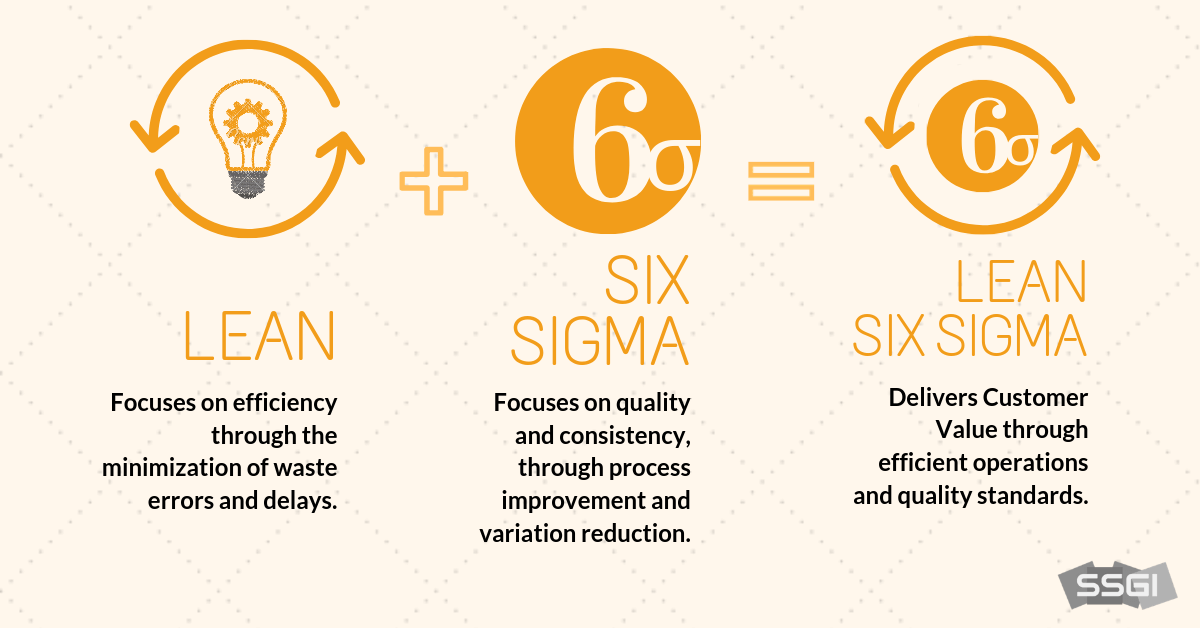
Lean is concerned with efficiency. It focuses on how operational processes are designed and managed to minimize inefficiencies that can be attributed to the following.
- Delays
- Errors
- Waste

LEAN CASE STUDY EXAMPLE (Lean in Practice)
Consider the challenges faced by the crew, staff and vendors of Royal Caribbean Cruise lines when the Symphony of the Seas docks early AM on Saturday mornings at the Port of Miami. Between 9AM and 4PM nearly 7,000 passengers depart the ship and another 7,000 board. While this is a challenge by itself, consider what goes on behind the scenes. More than 20,000 pieces of luggage must be moved, 2,759 staterooms cleaned, trash unloaded, and food supplies replenished. This carefully orchestrated process leaves no room for delays, errors or waste. Every step must be efficient. Or, to say this another way, the turnaround process must be Lean.
There are so many other situations where process efficiency is key to delivering customer value. Emergency departments at hospitals must be designed to minimize delays so patients can be seen soon after they arrive. On-line retailers must design logistics processes to minimize order processing delays and, in many cases, to deliver in one day, and manufacturing operations must be designed to minimize the waste associated with unnecessary process steps.
Lean Methodologies and Tools
Value Stream Mapping, 5S, and Kaizen.
What is Six Sigma?
Six Sigma focuses on:
- Quality
- Consistency
By consistency we mean delivering products and services that day-after-day meet quality standards; the product we deliver today is just like the one that is delivered tomorrow.
When we eat at a restaurant, purchase a new hard drive, or travel on an airplane, we expect a certain level of quality.
SIX SIGMA CASE STUDY EXAMPLE (Quality Failures in Practice)
Sometimes, companies fail to meet this challenge.
 Takata a Japanese manufacturer of auto airbags is one such example. These airbags relied on a compound of ammonium nitrate that expands upon impact, inflates the bag, and thereby protects the driver and passenger from head or body injuries.
However, the compound broke down when exposed to moisture and temperature swings. Some accidentally exploded sending metal fragments though the passenger compartment. In total 19 auto manufacturers recalled approximately 37 million vehicles in which over 50 million airbags were replaced. It was the largest recall in automotive history. Moreover, the human toll was substantial. Twelve people died and almost 200 were injured.
 Then there were the Boeing Max 8 disasters when two aircraft, within six months of each other, crashed shortly after takeoff. In total, 346 people died. The problem was traced to software problems in the Maneuvering Characteristics Augmentation System (MCAS). As part of the auto pilot system, the MCAS prevented the pilots from overriding the system and recovering from the steep descent. They tried to overcome the system controls but failed.
While the Takata and Boeing failures reached headline status, there are countless stories of quality failure, less known, but nonetheless underscoring the challenge that organizations face to assure their products and services meet quality standards.
The job of Six Sigma is to prevent these failures by instituting effective quality control processes at the manufacturing or service level before it’s too late.
This, then, is the difference between Lean and Six Sigma. Lean focuses on efficiency while Six Sigma focuses on quality. Both are essential to support sustained competitive positions in an industry.
Six Sigma Methodologies and Tools
DMAIC (Define, Measure, Analyze, Improve, Control), statistical analysis, and control charts.
What is Lean Six Sigma?
Lean Six Sigma serves as a hybrid approach that combines the best of Six Sigma (quality and consistency) with the best of Lean (efficiency) to help organizations deliver customer value through efficient operations and quality standards, which results in creating higher quality products and services. Because it’s approach tackles both issues, Lean Six Sigma has become the most popular methodology in industry. From healthcare to government agencies, Lean Six Sigma can be applied to almost any industry and any job function.
The benefits of Lean Six Sigma are widespread. These benefits help organizations to:
- Increase Profits
- Decrease Costs
- Improve Efficiency & Quality
- Improve Customer Satisfaction
- Enhance Employee Development
Lean Six Sigma Case Study Example (Combining Speed + Quality)
A hospital reduced patient wait times by 32% (Lean) while also cutting medication errors by 41% (Six Sigma) by redesigning intake flow and applying DMAIC to error-prone handoffs. This is the practical advantage of Lean Six Sigma: faster processes with more reliable outcomes.
How Lean Six Sigma improves business processes?
Lean Six Sigma improves business processes through reducing waste and defects, and enhancing efficiency and quality.
Is lean six sigma outdated?
Lean Six Sigma is not outdated. In fact, it is more relevant than ever as organizations face pressure to improve speed, quality, and efficiency at the same time. From projects to manufacturing to customer support, the methodologies of Lean Six Sigma play a critical role in ensuring operational efficiency, which is now the golden standard for almost every organization no matter the industry. Remember, efficiency and quality = Lean Six Sigma!
Lean Six Sigma Certification Belts
Which lean six sigma certification is best?
Certification in Lean Six Sigma as well as Six Sigma is broken down (beginner to advanced) into different belts. These belts indicate various levels based on expertise, experience and pre-existing knowledge. To determine which lean six sigma certification is best for you, first you must understand the associated belt levels.
The Lean Six Sigma Certification belts include:
Learn more about which Six Sigma Belt is right for you.
Should I do Lean or Six Sigma first?
Because Lean Six Sigma is a hybrid of both Lean and Six Sigma, the material covered in a Lean Six Sigma certification program generally covers everything that is also covered in a standard Six Sigma program. The only difference is that there is additional coverage of Lean in the material.
All three methodologies are designed to help organizations become more competitive in the marketplace. Those with knowledge in Lean, Six Sigma and Lean Six Sigma are in a position to add sustainable value and take a lead role on implementing process improvement initiatives. Competitive organizations value the concepts associated with Lean Six Sigma, which is why we recommend you first take a Lean Six Sigma program to get full coverage.
If you are interested in becoming certified, check out Six Sigma Global Institute for more information on Lean Six Sigma certification and training.

Lean vs Six Sigma vs Lean Six Sigma FAQsIs Lean the same as Six Sigma?
Is Lean Six Sigma the same as Lean or Six Sigma?
No. Lean Six Sigma is a hybrid methodology that combines Lean’s focus on efficiency with Six Sigma’s focus on quality and defect reduction.
Is Lean the same as Six Sigma?
No. Lean focuses on improving process flow and eliminating waste, while Six Sigma focuses on reducing defects and variation using data and statistical methods. They solve different types of problems and are often used together.
What is the difference between Lean Six Sigma and Six Sigma?
Six Sigma focuses primarily on reducing defects and process variation. Lean Six Sigma combines Six Sigma with Lean principles to improve both quality and efficiency by reducing waste and improving flow alongside defect reduction.
Is Lean Six Sigma better than Six Sigma?
Lean Six Sigma is often preferred because it addresses both efficiency and quality in one approach. It is not “better” in every situation, but it is more comprehensive for end-to-end process improvement.
Should I learn Lean or Six Sigma first?
Most professionals benefit from starting with Lean Six Sigma because it integrates both Lean and Six Sigma concepts into one methodology, providing a broader foundation for improving processes.
Is Lean Six Sigma outdated?
No. Lean Six Sigma is more relevant than ever as organizations face pressure to improve speed, quality, and efficiency at the same time across operations, services, and digital workflows.
Can Lean Six Sigma be used outside manufacturing?
Yes. Lean Six Sigma is widely used in healthcare, finance, government, IT, logistics, and service organizations to improve efficiency, quality, and customer experience.
Which Lean Six Sigma certification is best for beginners?
Yellow Belt is typically the best starting point for beginners, as it introduces core concepts and tools without requiring prior experience. Green Belt is appropriate for professionals who will lead improvement projects.
Do employers prefer Lean Six Sigma or Six Sigma?
Many employers prefer Lean Six Sigma because it combines efficiency and quality improvement. However, some roles may specifically value Six Sigma depending on the organization’s focus and maturity.
Is Lean Six Sigma harder than Six Sigma?
Lean Six Sigma is not necessarily harder, but it is broader. It covers both Lean and Six Sigma concepts, so it requires understanding a wider set of tools and problem-solving approaches.
Can Lean Six Sigma replace Six Sigma?
Lean Six Sigma does not replace Six Sigma, but it builds on it. Lean Six Sigma includes all core Six Sigma concepts while adding Lean principles to improve process flow and efficiency.