
?
What is a Scrum Master?
A Scrum Master is a key facilitator in Agile development, guiding teams through the Scrum framework and keeping them focused, efficient, and aligned. Unlike traditional managers, Scrum Masters lead by removing obstacles, promoting collaboration, and ensuring best practices are followed throughout each sprint.
This guide explains what a Scrum Master does, how the role differs from PM and Product Owner, and how to get certified.
In Agile environments, the Scrum Master plays a critical role in helping teams stay organized, focused, and continuously improving. Whether you’re new to Agile or considering a career shift, this guide will walk you through everything you need to know, from day-to-day responsibilities and team dynamics to certification options and career paths.
Why the Scrum Master Role Matters
Agile has transformed how teams operate, especially in software, IT, and project-driven industries. The Scrum Master ensures Agile principles aren’t just understood, but actively practiced, guiding the team through sprint planning, daily standups, sprint reviews, and retrospectives.
They don’t “manage” people, they manage the process and enable the people.
The Scrum Master turns Agile theory into daily practice. By coaching the team, removing impediments, and protecting focus, the Scrum Master improves flow, quality, and predictability. The result is faster delivery of valuable increments, clearer communication, and a healthier team culture built on continuous improvement.
How the role moves the needle:
Delivery speed: fewer blockers, tighter feedback loops, shorter cycle time
Quality: clear Definition of Done, early inspection, fewer defects escaping to production
Predictability: realistic sprint commitments, visible progress, stable velocity
Alignment: shared goals, transparent backlog, stakeholders engaged at the right moments
Team health: psychological safety, constructive retrospectives, sustainable pace
Signals you can measure: Cycle time, throughput, sprint goal success rate, defect escape rate, team happiness score, stakeholder satisfaction. The Scrum Master makes these metrics visible and helps the team improve them over time.
What Does a Scrum Master Do?
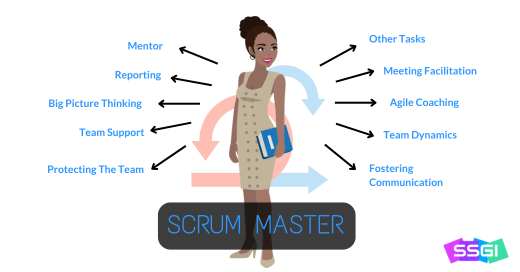
The Scrum Master is not a traditional team leader or project manager. Instead, they serve as a servant leader, guiding and supporting the Scrum Team so they can focus on delivering value. They ensure that the team adheres to Scrum principles and help remove any impediments to progress.
The Scrum Master is a facilitator and coach who helps the team apply Scrum effectively. They guide events, remove impediments, and strengthen collaboration so the team can deliver a usable increment every sprint.
A typical day in the role of a Scrum Master:
Before the Daily Scrum: review the board, check aging work, scan blockers and risks, prepare a brief focus for the standup
Daily Scrum (15 minutes): keep the conversation on the sprint goal, surface impediments, confirm next steps
Unblocking work: follow up on impediments, coordinate with stakeholders and leaders, escalate when needed
Backlog collaboration: partner with the Product Owner on refinement readiness, acceptance criteria clarity, and prioritization signals
Coaching and support: 1:1s with team members, reinforce working agreements, mentor on estimation, slicing, and quality practices
Information radiators: keep boards, burndown, and impediment logs current and visible
Continuous improvement: capture observations for the next retrospective, ensure action items from the last retro have owners and dates
Key touch-points:
- With the Product Owner: backlog refinement quality, sprint goal clarity, stakeholder feedback loops
- With the Developers: flow efficiency, limiting work in progress, test and deployment practices
- With stakeholders: expectations, transparency, access for reviews and demos
Common outputs: A clear sprint goal, an updated board, an active impediment log, agreed working agreements, and a short list of retro actions that actually get done.
Key Responsibilities of a Scrum Master
The Scrum Master plays a crucial role in Agile project management by ensuring that the Scrum framework is implemented effectively and that teams stay focused, efficient, and collaborative. Acting as a servant leader, the Scrum Master supports the development team, Product Owner, and broader organization by coaching team members, facilitating communication, and removing roadblocks that hinder progress.
More than just a meeting organizer, the Scrum Master is responsible for aligning the team with Agile principles, enabling a culture of continuous improvement, and driving productivity across each sprint.
Here are the core responsibilities of a Scrum Master:
Daily Standups
Facilitate daily Scrum meetings to ensure alignment, transparency, and accountability.
Sprint Planning
Guide the team through planning sessions to break down work into manageable tasks and set realistic goals.
Sprint Reviews & Retrospectives
Help the team reflect on performance, gather feedback, and identify opportunities for process improvements.
Obstacle Removal
Actively identify and eliminate blockers that slow down team progress or workflow.
Team Shielding
Protect the team from external distractions and unnecessary interference from stakeholders.
Agile Coaching
Promote Agile principles by coaching both team members and stakeholders on Scrum roles, values, and best practices.
Process Optimization
Continuously seek ways to improve team dynamics, sprint efficiency, and product delivery cadence.
Stakeholder Liaison
Serve as a bridge between the development team and external stakeholders, facilitating clear and constructive communication.
Tool & Board Administration
Manage Scrum tools (e.g., Jira, Trello) and ensure Scrum boards and progress trackers are kept up-to-date.

Scrum Team Roles at a Glance
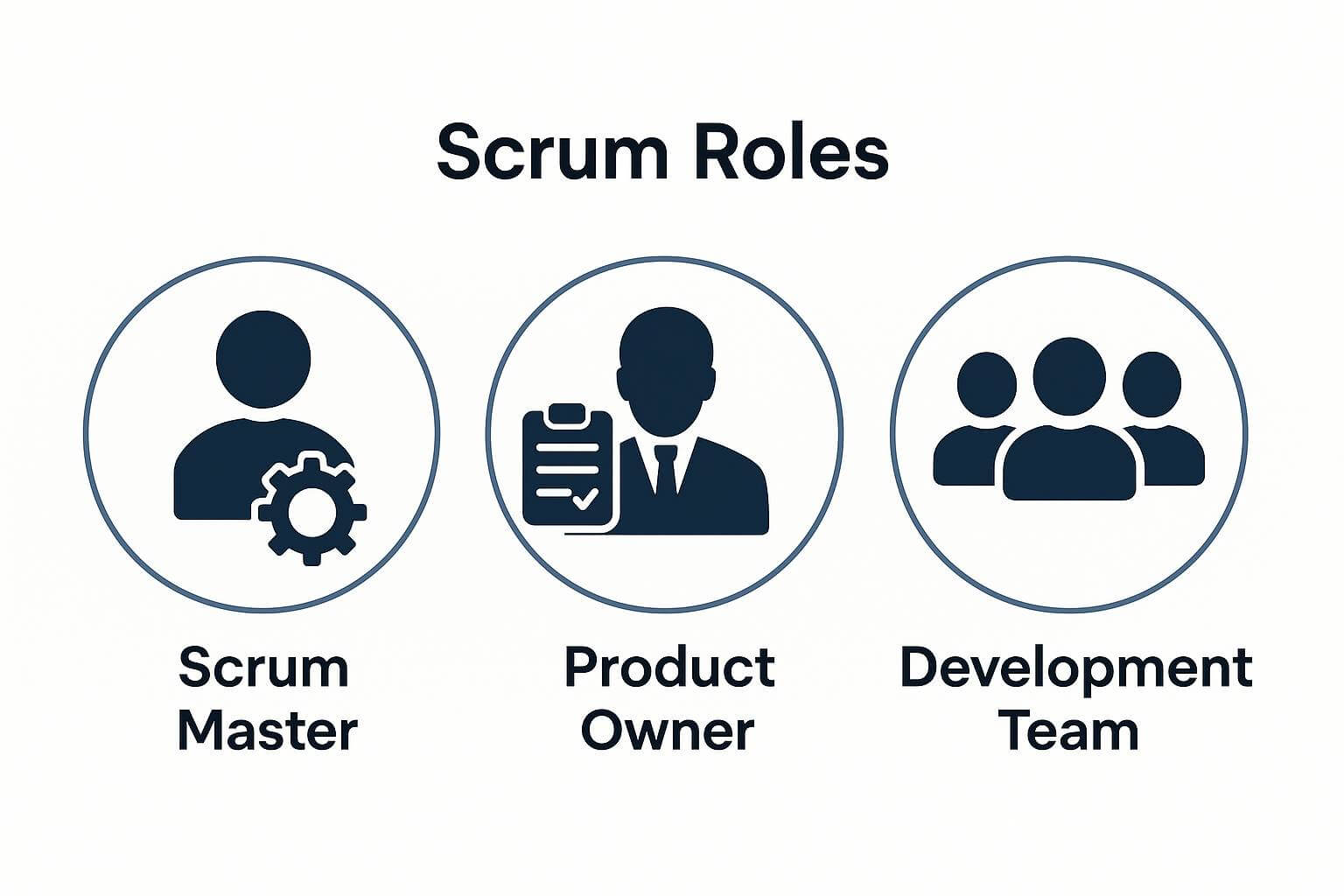 In Scrum there are 3 main roles:
Product Owner: sets product vision, orders the backlog, clarifies acceptance criteria, accepts or rejects work.
Developers: cross-functional team that plans, builds, tests, and delivers a usable increment each sprint; self-managing; accountable for quality.
Scrum Master: facilitates Scrum, removes impediments, protects focus, coaches on continuous improvement.
Want the full breakdown of duties, roles and responsibilities?
Scrum Master vs. Project Manager
Although the Scrum Master and Project Manager roles might appear similar at first glance, both guiding teams, fostering collaboration, and ensuring progress, they are fundamentally different in approach, focus, and philosophy.
A Project Manager typically works within traditional (often Waterfall) project frameworks. Their responsibilities include setting project timelines, managing budgets, allocating resources, and ensuring deliverables are met according to plan. They hold authority over the project scope and are ultimately accountable for its success or failure.
The Scrum Master, in contrast, operates within an Agile environment, where flexibility, adaptation, and team empowerment are key. Rather than directing the team, the Scrum Master serves as a coach and facilitator, removing obstacles, promoting Agile best practices, and helping the team self-organize. They don’t manage deadlines or assign tasks, instead, they empower the team to take ownership of how the work gets done.
Understanding these differences is crucial for organizations adopting Agile. While both roles are valuable, their functions are not interchangeable. Businesses transitioning to Agile methodologies often shift responsibilities from traditional project managers to Scrum Masters to better align with the values of continuous improvement and iterative development.
| Aspect | Scrum Master | Project Manager |
|---|---|---|
| Primary Focus | Facilitates Agile processes | Plans and manages project scope/timeline |
| Main Responsibility | Focuses on team support and coaching | Oversees resource allocation and reporting |
| Leadership Style | Servant leader | Traditional leadership role |
| Accountability | Not responsible for deliverables | Accountable for project deliverables |
Scrum Master vs. Product Owner
The Scrum Master and Product Owner are two of the most critical roles within any Agile team, but their responsibilities are distinctly different. Understanding the contrast between them is essential for maintaining a productive and efficient Scrum process.
The Scrum Master is focused on how the team works. Acting as a servant leader, they ensure the Scrum framework is followed, facilitate meetings like daily stand-ups and retrospectives, and remove impediments that block team progress. Their primary mission is to create an environment where the team can perform at its best without unnecessary disruptions.
On the other hand, the Product Owner is focused on what the team works on. As the voice of the customer and primary business representative within the Scrum team, the Product Owner maintains and prioritizes the product backlog. They define the vision for the product, clarify user stories, and ensure that the most valuable features are delivered first.
These roles complement each other, one guiding the process, the other shaping the product vision. When executed well, the collaboration between the Scrum Master and Product Owner leads to higher efficiency, better product-market fit, and happier stakeholders. Each role must stay in its lane, yet work closely to drive continuous value delivery.
| Aspect | Scrum Master | Product Owner |
|---|---|---|
| Primary Focus | Process, team dynamics, and adherence to Scrum framework | Maximizing product value and managing the product backlog |
| Main Responsibility | Ensures team follows Scrum principles and removes blockers | Defines and prioritizes product features based on stakeholder input |
| Interaction With Team | Coaches and facilitates the team | Provides user stories and accepts deliverables |
| Key Activities | Sprint planning, stand-ups, retrospectives, removing impediments | Backlog grooming, stakeholder communication, writing acceptance criteria |
| Reports To | The Scrum team and organization (as a facilitator) | Stakeholders and customers |
| Mindset | Servant leader, coach, protector of the team | Visionary, decision-maker, voice of the customer |
| Authority Over Work | None—focuses on how work is done | Full authority over what work gets prioritized and delivered |
Daily Activities of a Scrum Master
The Scrum Master’s day is about protecting focus, improving flow, and enabling the team to deliver a usable increment. Here is a practical, copy-paste section you can use.
Morning focus
- Review the board: aging work, blocked items, WIP limits, sprint goal alignment
Check metrics: burndown, cycle time outliers, throughput trends
Scan risks and dependencies and line up any quick conversations needed
Daily Scrum (15 minutes)
- Keep the conversation tied to the sprint goal
Surface and capture impediments in an impediment log
Confirm next steps and owners for the next 24 hours
Unblock and enable
- Coordinate with stakeholders or other teams to remove impediments
Secure decisions, resources, and access needed for progress
Escalate only when local solutions are exhausted
Backlog and planning support
- Partner with the Product Owner on refinement readiness, acceptance criteria, and prioritization
Help the team slice work into small, testable pieces and estimate consistently
Validate that the sprint backlog still reflects reality after changes
Coaching and team health
- Short 1:1s to support collaboration and address friction
Reinforce working agreements, Definition of Done, and quality practices
Facilitate quick micro-workshops when a practice needs a boost
Information radiators
- Keep the board, burndown, and impediment log current and visible
Share concise status updates that highlight outcomes, not activity
Ensure stakeholders know when and how to give feedback
End-of-day hygiene
- Review open impediments and owner follow-ups
Capture observations and potential improvements for the next retrospective
Confirm that retro action items have owners and dates
Weekly cadence anchors
- Sprint Planning: clarify sprint goal, capacity, and acceptance criteria
Backlog Refinement: maintain a ready queue of small, clear items
Sprint Review: gather feedback from stakeholders and inspect the increment
Retrospective: select 1–3 improvement actions that are small, specific, and time-bound
Artifacts the Scrum Master keeps healthy
- Sprint board and Definition of Done
Working agreements and impediment log
Lightweight dashboard: sprint goal status, burndown, blockers, escaped defects
Signals that the day went well
- Fewer blockers and faster resolution times
Clear next steps for each active item
Stable progress toward the sprint goal and visible ownership across the team
Key Skills for Scrum Masters
Scrum Masters blend facilitation, coaching, and light technical fluency to help teams deliver consistently. Here are the essentials, with practical proof points you can use on a resume or in interviews.
Communication and facilitation
Runs clear, time-boxed events, keeps discussions focused on the sprint goal, and makes decisions and next steps explicit.
Coaching and mentoring
Helps teams adopt Scrum practices, improves estimation and story slicing, and nurtures self-organization without taking control.
Conflict resolution
Surfaces tensions early, mediates disagreements, and guides the team to agreements that protect flow and quality.
Leadership without authority
Influences through trust and clarity, not hierarchy. Protects focus, upholds working agreements, and models the Scrum values.
Stakeholder management
Sets expectations, creates transparent feedback loops, and brings the right stakeholders to Sprint Reviews at the right time.
Process improvement mindset
Turns retro insights into small, time-bound actions. Tracks follow-through and impact on flow and quality.
Data literacy and metrics
Reads burndown, cycle time, and throughput. Spots aging work, WIP problems, and blockers, then acts to improve predictability.
Backlog and delivery support
Partners with the Product Owner on readiness, acceptance criteria, and priority signals. Helps the team keep the sprint backlog realistic.
Tool proficiency
Keeps information radiators accurate in Jira, Trello, or Azure DevOps. Comfortable with boards, queries, dashboards, and basic automation.
Change enablement
Guides teams through adopting new practices, builds psychological safety, and sustains a culture of continuous improvement.
Common tools
Jira, Trello, Azure DevOps, Confluence, Miro or FigJam for collaboration, lightweight dashboards for burndown and flow metrics.
How to Become a Scrum Master
There’s no single path, but here’s a practical route to follow:
Learn the fundamentals of Scrum and Agile (e.g., through a beginner course).
Get certified through a recognized provider (e.g., SSGI, PMI, Scrum.org).
Apply your knowledge in real-world projects, even in a non-official role.
Develop soft skills like facilitation, coaching, and team dynamics.
Looking to fast-track your career? Our Scrum Master Certification is 100% online, self-paced, and developed by industry experts.
Scrum Master Certifications
There are several certifications that validate your knowledge and skills:
- Certified ScrumMaster (CSM) – Scrum Alliance
- Professional Scrum Master (PSM I, II, III) – Scrum.org
- SAFe Scrum Master (SSM) – Scaled Agile
- SSGI Scrum Master Certification – Six Sigma Global Institute
While certification is helpful, employers also value practical experience and a strong grasp of Agile principles.
Scrum Master Salary and Career Outlook
Scrum Master pay is strong across tech, finance, healthcare, and government, with growth paths into senior delivery and coaching roles. Exact figures vary by location, industry, and team size, but these typical U.S. ranges are a useful guide:
Typical salary bands:
Entry level: $75,000–$95,000
Mid level: $95,000–$120,000
Senior: $120,000–$150,000
Agile Coach or RTE: $135,000–$170,000+
Scrum Master roles often lead to higher-level positions like: Agile Coach, Product Owner, Program Manager and Delivery Manager
Market outlook:
Organizations continue adopting Agile to handle complex products and faster release cycles. Demand is healthy for Scrum Masters who show real impact, especially those who can coach multiple teams, work in scaled frameworks, and use data to guide improvement.
Next step:
Ready to position yourself for the next salary band and stronger roles? Build job-ready skills with the SSGI Scrum Master Certification and add measurable outcomes to your resume.
Understanding the Scrum Framework
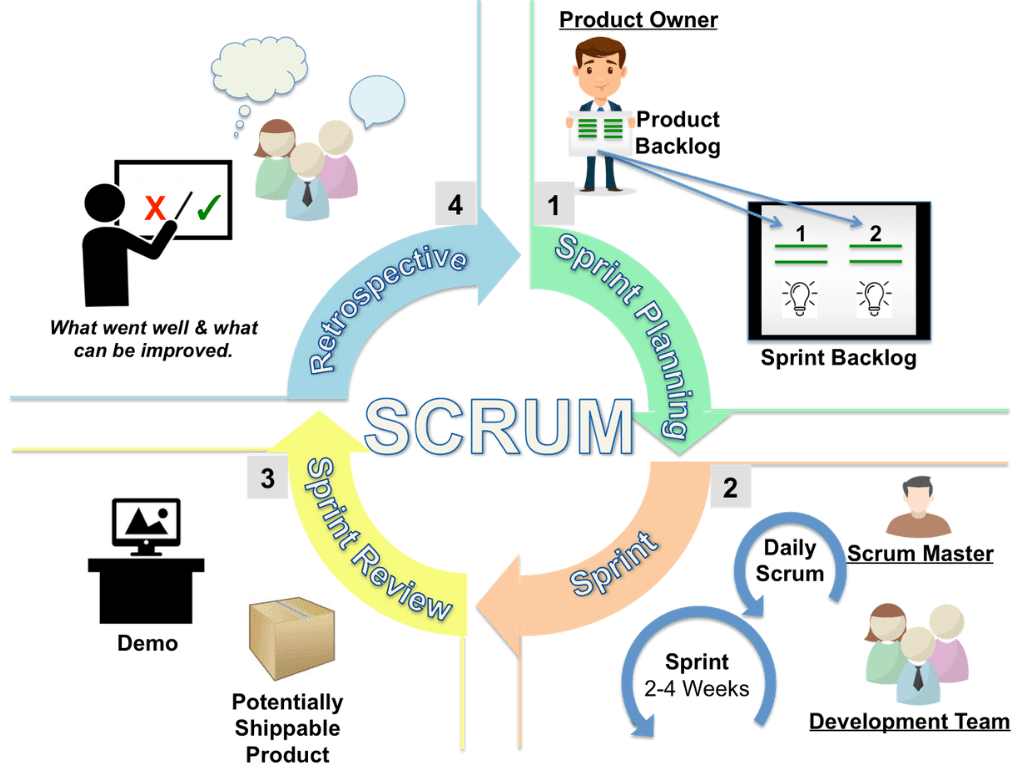
The Scrum framework is a structured yet flexible approach to Agile project management. It helps teams break down complex work, improve collaboration, and deliver value incrementally. At its core, Scrum consists of a few key components:
Sprints
Time-boxed work cycles (usually 1–4 weeks) where teams focus on completing a specific set of tasks or features. Each sprint has a clear goal and a fixed timeframe.
Product Backlog
A living, prioritized list of everything the product might need—features, improvements, bug fixes, and technical tasks—managed by the Product Owner.
Sprint Backlog
I am text block. Click edit button to change this text. Lorem ipsum dolor sit amet, consectetur adipiscing elit. Ut elit tellus, luctus nec ullamcorper mattis, pulvinar dapibus leo.
Scrum Artifacts
Tools that increase transparency and track progress. Examples include:
- Burndown Charts: Visualize remaining work over time.
- Task Boards: Help teams manage and monitor sprint progress.
Scrum Events
A cadence of recurring meetings that promote alignment and adaptation:
- Sprint Planning: Define what will be done in the sprint.
- Daily Stand-ups: Quick check-ins to sync up.
- Sprint Review: Share what was accomplished and gather feedback.
- Sprint Retrospective: Reflect on what went well and what can improve.
Why Scrum Matters
Scrum’s structure creates rhythm, accountability, and transparency—while still allowing teams to pivot and improve. It’s ideal for fast-moving environments that demand high-quality outcomes and rapid iterations.
See the visual below that shows the Scrum Framework in motion.
Final Thoughts
The Scrum Master is a vital player in any Agile team. More than just a facilitator, they are champions of continuous improvement, culture, and agility. If you’re passionate about helping teams succeed and improving workflows, becoming a Scrum Master can be a rewarding and impactful career path.
Ready to explore Scrum Master certification? Visit our Scrum Master Course Page to learn more and get started today.
Scrum Master FAQs
1. What is a Scrum Master?
A Scrum Master is a facilitator and servant leader who ensures a Scrum team follows Agile principles and the Scrum framework. They help the team stay focused, remove roadblocks, and improve processes continuously.
2. What does a Scrum Master do day-to-day?
A Scrum Master leads daily stand-ups, facilitates sprint planning and retrospectives, removes blockers, supports team collaboration, and ensures Scrum principles are followed across the team.
3. Do Scrum Masters write code?
Typically, Scrum Masters do not write code. Their primary role is to support the development team, coach on Agile practices, and facilitate smooth team operations—not contribute to technical deliverables.
4. How is a Scrum Master different from a Project Manager?
A Project Manager controls scope, budget, and timeline, while a Scrum Master empowers the team, promotes self-organization, and facilitates Agile ceremonies without managing the team directly.
5. Is Scrum Master a full-time role?
Yes, in most organizations, the Scrum Master is a full-time role, especially for larger teams or companies running multiple Agile projects.
6. Do I need a Scrum Master certification?
While not always required, Scrum Master certifications (like CSM or SSGI’s Scrum Master) can validate your knowledge and make you more competitive in the job market.
7. Can you be a Scrum Master without experience?
It’s possible to start as a Scrum Master without prior experience, especially if you gain certification and understand Agile principles deeply. Many entry-level roles value strong communication and facilitation skills.
8. What skills are required to become a Scrum Master?
Key skills include leadership, communication, conflict resolution, coaching, and a strong understanding of Scrum, Agile, and team dynamics.
9. What tools does a Scrum Master use?
Scrum Masters commonly use tools like Jira, Trello, Asana, Confluence, Miro, and other Agile project management or collaboration platforms to support sprint planning and team coordination.
10. Is Scrum Master a good career path?
Yes, it’s a growing career path with strong demand across tech, finance, healthcare, and more. It offers opportunities to move into Agile coaching, product ownership, or senior leadership.
11. What is the difference between a Scrum Master and a Product Owner?
The Scrum Master ensures the process runs smoothly; the Product Owner ensures the right product is being built. Both work closely but focus on different priorities.
12. Do you need experience to become a Scrum Master?
Not necessarily. Many entry-level roles accept certified candidates with a strong understanding of Agile principles—even if you haven’t held the title before.