Lean Six Sigma by Industry
How organizations across different sectors apply Lean Six Sigma to improve performance, reduce waste, and drive measurable results.

How organizations across different sectors apply Lean Six Sigma to improve performance, reduce waste, and drive measurable results.
Lean Six Sigma is not a one-size-fits-all methodology.
While the core principles remain consistent, how they are applied varies significantly by industry, regulatory environment, and operational context.
On this page, you’ll find an overview of how Lean Six Sigma is used across major industries, including manufacturing, healthcare, technology, finance, government, and more. Each industry page explores real-world applications, common challenges, and how Lean Six Sigma drives measurable improvement in that sector.
Lean Six Sigma is adaptable to any workflow. Explore how organizations in your sector use data-driven improvement to strengthen quality, reduce waste, and improve performance.
Finance
Increase accuracy, compliance, and end-to-end process efficiency.
Healthcare
Improve patient flow, quality, safety, and operational efficiency.
Education
Enhance administrative efficiency and support consistent service delivery.
Food & Beverage
Reduce waste, improve quality consistency, and strengthen food safety systems.
Government
Streamline services, reduce waste, and improve program outcomes.
Technology & IT
Optimize processes, reduce rework, and scale operations effectively.
Supply Chain & Logistics
Improve flow, reduce delays, and strengthen reliability across networks.
Manufacturing
Reduce defects, cycle time, and production variation.
SSGI is the Industry Trusted Provider

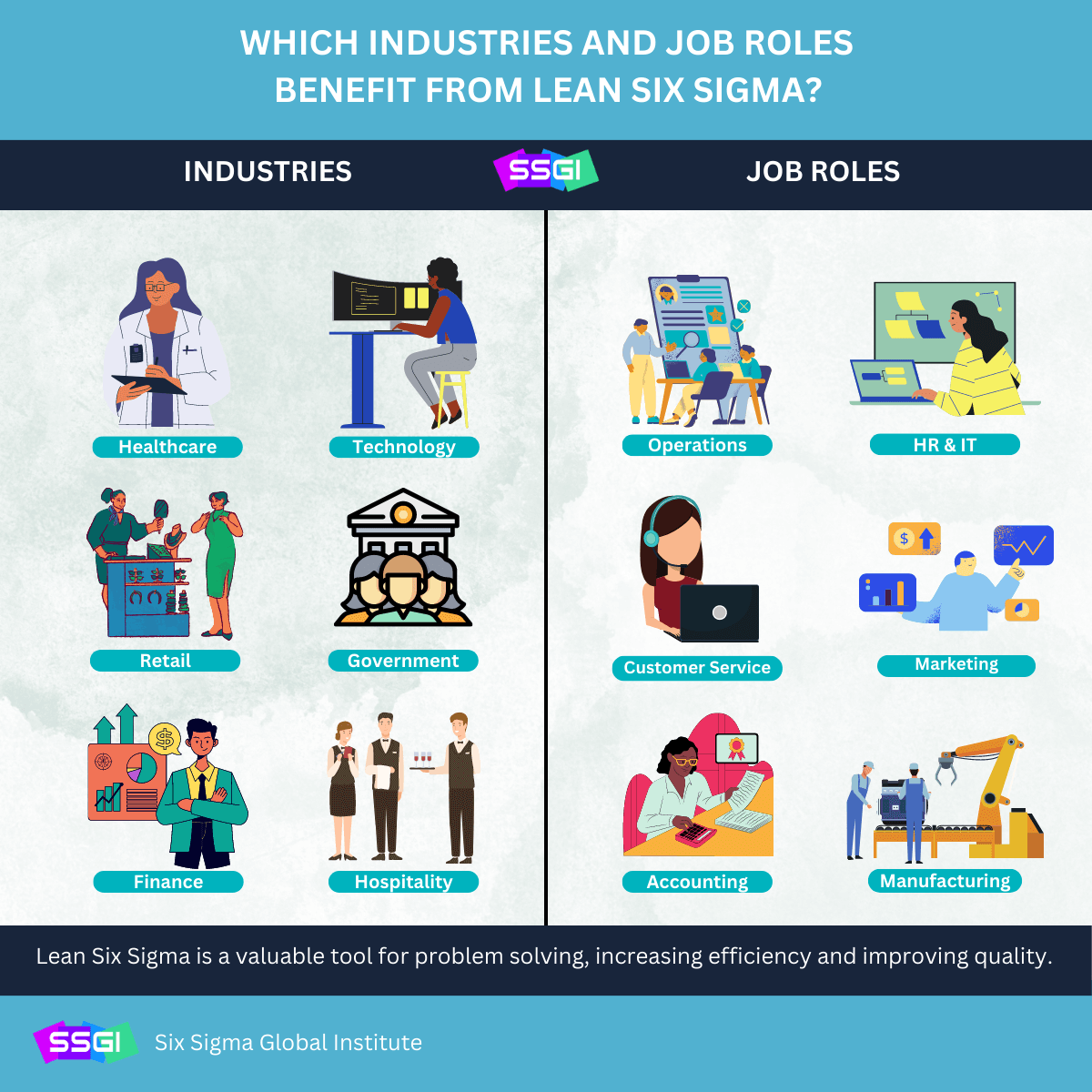
Lean Six Sigma is effective everywhere because its principles apply to any workflow — physical or digital, public or private.
Organizations rely on Lean Six Sigma to:
Identify and eliminate waste
Reduce variation and errors
Improve speed and consistency
Create more predictable outcomes
Build a culture of continuous improvement
Regardless of industry, Lean Six Sigma provides a structured way to improve performance and deliver better results.
While industry contexts differ, Lean Six Sigma is commonly used to improve efficiency, reduce variation, strengthen quality systems, and support data-driven decision-making. Industry-specific constraints such as regulation, customer expectations, and operational complexity shape how tools and methods are applied.
Common challenges include:
Regulatory requirements and compliance constraints
Legacy processes and technology limitations
Cross-functional coordination and change resistance
Data availability and measurement challenges
Applying Lean Six Sigma effectively requires more than understanding tools. It requires aligning methods to industry realities, organizational maturity, and operational risk. Programs that ignore context often struggle to sustain results, while industry-aligned approaches drive long-term improvement.
Yes. Lean Six Sigma is widely used in healthcare, finance, technology, government, and service industries where efficiency, quality, and consistency are critical.
The core principles remain consistent, but tools, examples, and implementation approaches vary based on industry requirements and constraints.
Any industry with repeatable processes, measurable outcomes, and a focus on improvement can benefit from Lean Six Sigma.
Choose your industry above to learn how Lean Six Sigma applies to your field, see real-world use cases, and find training options to help you advance your career.