Should I Get a Six Sigma Green Belt or Black Belt?
Compare Green Belt vs. Black Belt certifications and learn which Six Sigma certification best matches your experience, career goals, and the type of improvement work you want to lead.

Compare Green Belt vs. Black Belt certifications and learn which Six Sigma certification best matches your experience, career goals, and the type of improvement work you want to lead.
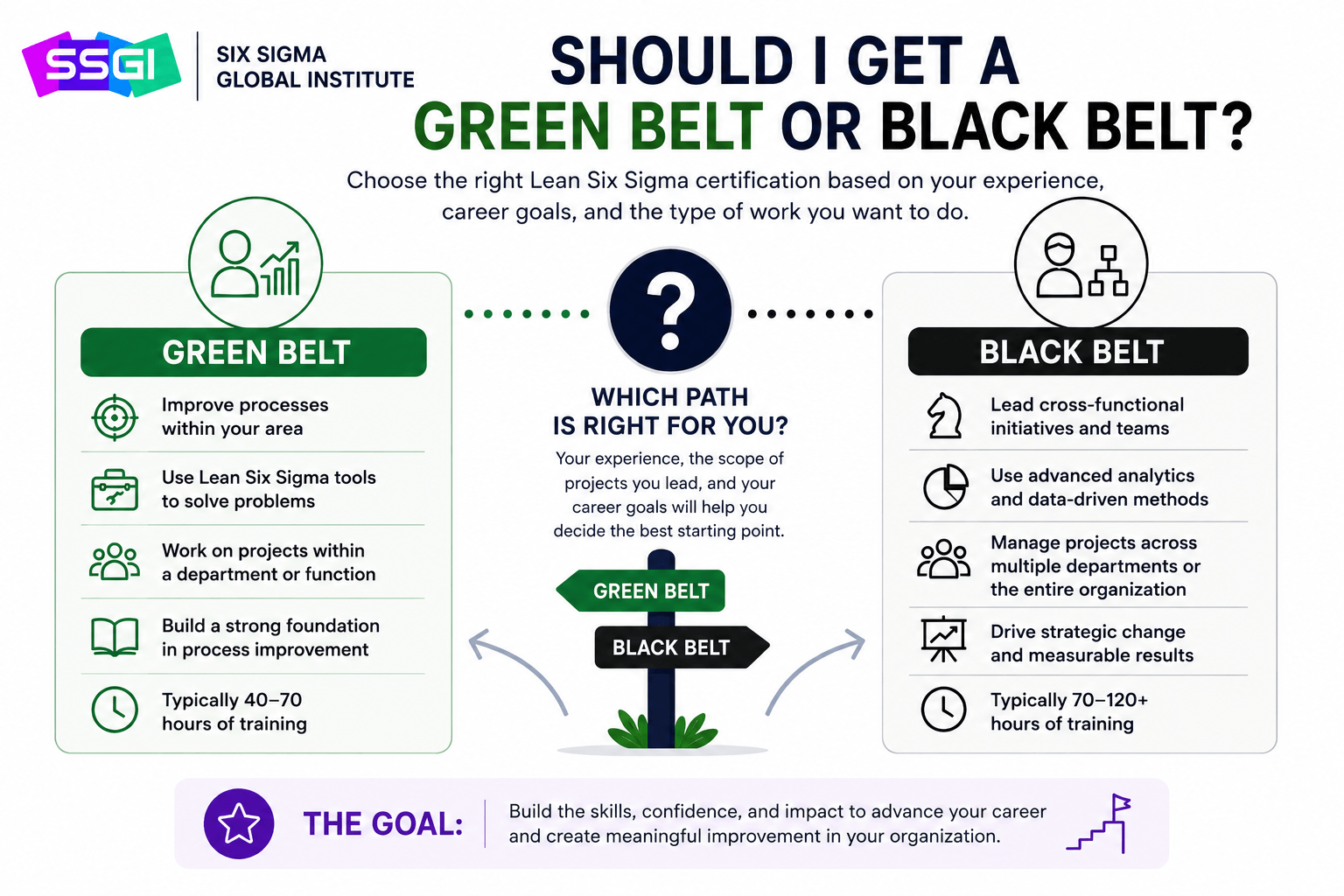
One of the most common questions professionals ask before pursuing Lean Six Sigma certification is:
“Should I get a Green Belt or Black Belt?”
The answer isn’t simply that one certification is “better” than the other.
The right choice depends on your experience, the type of work you currently perform, the responsibilities you hope to take on, and how familiar you already are with process improvement.
For some professionals, Green Belt provides the ideal foundation for learning Lean Six Sigma principles and applying them to real business problems.
For others, particularly those who already have significant experience leading projects and improving operations, Black Belt may be the more appropriate starting point.
This guide compares Green Belt and Black Belt certifications, explains the differences in responsibilities and career paths, and helps you determine which certification best aligns with your goals.
The right choice depends on your current experience, responsibilities, and the type of improvement work you want to lead.
Still not sure? Keep reading to compare Green Belt and Black Belt side by side, including responsibilities, leadership expectations, salary potential, career paths, and which certification may be the better fit for your profession.
Both certifications build Lean Six Sigma problem-solving skills, but they are designed for different levels of experience, responsibility, analytical depth, and project leadership.
| Category | Green Belt | Black Belt |
|---|---|---|
| Best For | Professionals building or formalizing process improvement skills | Experienced professionals ready to lead larger improvement initiatives |
| Typical Role | Leads or supports departmental improvement projects | Leads complex, cross-functional improvement projects |
| Project Scope | Departmental or functional projects | Cross-functional or organization-wide initiatives |
| Lean Six Sigma Depth | Comprehensive working knowledge of Lean Six Sigma tools and methodology | Advanced application of Lean Six Sigma, analytics, leadership, and project strategy |
| Statistical Analysis | Intermediate | Advanced |
| Leadership Scope | Team or departmental level | Cross-functional or organizational level |
| Difficulty | Intermediate | Advanced |
| Typical Study Time | Approximately 40–70 hours, depending on the provider | Approximately 70–120+ hours, depending on the provider |
| Career Goal | Develop practical process improvement and project leadership skills | Lead complex improvement initiatives and operational excellence efforts |
| Best Starting Point? | Usually yes for professionals new to formal Lean Six Sigma training | Can be appropriate for experienced professionals with substantial project or improvement experience |
| Next Step | Advance to Black Belt as experience and responsibilities grow | Continue toward Master Black Belt or broader operational excellence leadership |
Bottom line: Green Belt is generally the stronger starting point for professionals building practical Lean Six Sigma skills and preparing to lead improvement projects. Black Belt is better suited to experienced professionals who are ready to lead larger, cross-functional initiatives and take on greater analytical and leadership responsibility.
The sections below take a closer look at what each certification covers, how Green Belt and Black Belt responsibilities differ, whether you can go straight to Black Belt, and which certification may be the better fit for your career.
A Lean Six Sigma Green Belt is a professional who has the knowledge and skills to identify process problems, analyze data, reduce waste, and implement measurable improvements within an organization.
Green Belts often lead improvement projects within their own department or functional area while collaborating with cross-functional teams to improve quality, efficiency, customer satisfaction, and business performance.
For many professionals, Green Belt represents the ideal balance between practical problem-solving and leadership. It provides a comprehensive understanding of Lean Six Sigma without requiring the advanced statistical analysis and organizational leadership typically associated with Black Belt.
Explore the Green Belt curriculum, training format, certification exam, and what you'll learn.
If you’re completely new to Lean Six Sigma and wondering whether Green Belt is the right starting point, you may also want to compare Yellow Belt vs. Green Belt before making your decision.
A Lean Six Sigma Black Belt is a professional who leads larger, more complex process improvement initiatives that often span multiple departments or business functions. Black Belts combine advanced analytical skills with project leadership, change management, and strategic decision-making to help organizations improve quality, reduce costs, and achieve measurable business results.
While Green Belts typically focus on improvements within their own department, Black Belts are expected to lead cross-functional teams, mentor others, and guide projects that have a broader organizational impact.
Black Belt certification builds upon Lean Six Sigma principles while expanding into more advanced statistical analysis, leadership techniques, and project management skills. For professionals who already have significant experience improving processes or leading operational initiatives, Black Belt can be the logical next step.
Explore the Black Belt curriculum, certification requirements, exam details, and advanced Lean Six Sigma skills you'll develop.
The biggest difference between a Six Sigma Green Belt and Black Belt isn’t simply the amount of training or the color of the certification.
It’s the scope of the problems you’re expected to solve.
Green Belts typically focus on improving processes within a team, department, or functional area. They use Lean Six Sigma tools to identify problems, analyze data, reduce waste and variation, and implement measurable improvements.
Black Belts operate at a broader level. They are more likely to lead complex, cross-functional initiatives that involve multiple departments, larger business objectives, and greater responsibility for project leadership, stakeholder alignment, and organizational change.
Focuses on solving process problems and leading improvements within a team, department, or functional area.
Leads larger, cross-functional initiatives that require deeper analysis, stakeholder management, and broader organizational impact.
Put simply, a Green Belt is often responsible for improving a process, while a Black Belt is increasingly responsible for leading the people, analysis, and strategy required to improve multiple processes or broader business performance.
That difference in scope is why your current experience and responsibilities matter more than simply choosing the higher certification level.
| Your Situation | Recommended Certification | Why? |
|---|---|---|
| 🎓 Recent graduate | Green Belt | Build a strong Lean Six Sigma foundation before taking on advanced leadership topics. |
| ⚙️ Engineer | Green Belt | Develop structured problem-solving skills that can immediately improve engineering processes. |
| 🏥 Healthcare professional | Green Belt | Learn practical improvement tools that enhance patient care and operational efficiency. |
| 📊 Operations Manager (10+ years) | Often Black Belt | Existing leadership experience often makes Black Belt a logical next step. |
| 📈 Continuous Improvement Manager | Black Belt | Black Belt aligns with leading larger improvement initiatives and mentoring others. |
| 📋 Project Manager | Depends | Choose Green Belt if you're new to Lean Six Sigma. Choose Black Belt if you already lead complex operational improvements. |
| 🏭 Manufacturing Supervisor | Green Belt | Green Belt provides practical tools that can immediately improve production and quality. |
| 🏢 Director or Senior Operations Leader | Often Black Belt | The role often requires broader leadership, advanced analytics, and organizational change management. |
Your job title alone shouldn’t determine whether you choose Green Belt or Black Belt. The better indicator is the type of problems you solve, the scope of the projects you lead, and how much Lean Six Sigma experience you already have. The examples below explain how that decision often looks across several common professions.
Engineers often benefit from Green Belt because it develops structured problem-solving, data analysis, process improvement, and waste-reduction skills that can be applied immediately. Engineers already leading complex, cross-functional improvement initiatives may find Black Belt more appropriate.
Green Belt is a strong choice for Operations Managers who are newer to formal Lean Six Sigma training and want practical tools for improving day-to-day performance. Experienced Operations Managers already responsible for major cross-functional initiatives, cost reduction, or operational transformation may be ready for Black Belt.
Green Belt is often the strongest starting point for healthcare professionals looking to improve patient flow, quality, efficiency, and administrative or clinical processes. Black Belt becomes more appropriate for professionals leading hospital-wide, system-wide, or enterprise quality initiatives.
Green Belt is highly applicable for manufacturing supervisors, engineers, production leaders, and quality professionals who want to reduce defects, eliminate waste, and improve process performance. Black Belt is better suited to professionals leading plant-wide, multi-site, or strategic manufacturing improvement efforts.
Project Managers already possess leadership and stakeholder-management skills that complement Lean Six Sigma. Green Belt adds a structured process-improvement and analytical framework, while Black Belt may make more sense for experienced project leaders responsible for large operational transformation or continuous improvement programs.
Business Analysts frequently identify process gaps, analyze performance, gather requirements, and recommend improvements, making Green Belt a natural complement to their existing skill set. Analysts already leading enterprise transformation or operational strategy initiatives may benefit from Black Belt.
The key takeaway: profession matters, but responsibility matters more. Two people with the same job title may need different certification levels depending on the scale of the projects they lead and the experience they already have.
Use this quick decision guide to narrow down the best starting point.
Build a strong Lean Six Sigma foundation and gain experience applying the methodology before moving to more advanced work.
This is a general guide. Your experience, career goals, and the requirements of the certification provider should also be considered.
The short answer is yes, but that doesn’t necessarily mean you should.
Many professionals assume the goal is to earn the highest certification as quickly as possible. In reality, the best starting point depends on your experience, responsibilities, and familiarity with Lean Six Sigma principles.
In many certification programs, you can enroll directly in Black Belt without first earning a Green Belt. However, whether that is the right decision depends on your background, not simply whether it’s allowed. Some organizations may also have their own internal requirements or preferred certification paths, so it’s worth checking whether your employer has specific expectations.
Professionals who already have significant experience leading process improvement initiatives, managing cross-functional projects, or driving operational excellence may be good candidates to begin with Black Belt.
If you’re new to Lean Six Sigma or have never formally studied the methodology, Green Belt usually provides the strongest foundation. Building that understanding first makes the more advanced analytical and leadership concepts introduced in Black Belt much easier to apply successfully.
Rather than asking:
“Can I skip Green Belt?”
A better question is:
“Will skipping Green Belt help me become more effective, or simply help me earn a higher certification faster?”
For many professionals, Green Belt provides the knowledge, confidence, and practical experience needed to get much more value from Black Belt later in their career.
One of the biggest misconceptions about Lean Six Sigma certification is that employers always prefer Black Belt over Green Belt.
In reality, most employers aren’t simply looking for the highest belt. They’re looking for professionals who can improve processes, solve business problems, and deliver measurable results.
A Green Belt who can confidently explain how they identified waste, analyzed data, and improved a process will often make a stronger impression than someone with a Black Belt who struggles to discuss how they would approach a real improvement project.
Employers generally want to know:
✔ Can you solve problems using a structured methodology?
✔ Can you analyze data and make informed decisions?
✔ Can you improve processes that reduce cost, improve quality, or increase efficiency?
✔ Can you communicate your recommendations and influence others?
✔ Can you lead projects and deliver measurable business results?
The certification helps demonstrate your commitment to professional development, but your ability to explain how you apply Lean Six Sigma principles is ultimately what differentiates you during interviews and on the job.
For that reason, choosing the certification that best matches your current experience and career goals is usually more valuable than simply pursuing the highest belt available.
If you’re still deciding whether Lean Six Sigma is the right investment for your career, our guide on Is Six Sigma Worth It? explores the career benefits, ROI, and situations where certification provides the greatest value.
Many professionals assume earning a Black Belt automatically leads to a higher salary than earning a Green Belt.
The reality is a little more nuanced.
While Black Belt holders often earn more on average, that difference is largely because they tend to work in more senior positions with greater responsibility. Experience, job title, industry, geographic location, and the scope of your role typically have a much greater impact on compensation than the certification alone.
For example, a highly experienced Operations Manager with a Green Belt may earn considerably more than a newly certified Black Belt who has limited real-world experience. Likewise, professionals working in healthcare, manufacturing, aerospace, finance, consulting, and technology often see different salary ranges depending on their industry and responsibilities. If you’re interested in current compensation trends across different industries and job titles, see our guide to Lean Six Sigma salaries and career paths.
That said, Black Belt certification is commonly associated with leadership roles, larger improvement initiatives, and broader organizational responsibility. Because of this, salary surveys frequently report higher average compensation for Black Belt holders than Green Belt holders.
Ultimately, certification should be viewed as an investment in your long-term career rather than a guarantee of a specific salary. The professionals who typically see the greatest career growth are those who combine strong Lean Six Sigma knowledge with the ability to solve real business problems and deliver measurable results.
| Factor | Green Belt | Black Belt |
|---|---|---|
| Typical Role | Departmental process improvement | Cross-functional improvement leadership |
| Experience Level | Early to mid-career | Mid to senior-level |
| Leadership Responsibility | Project participation or departmental leadership | Enterprise-wide projects and strategic leadership |
| Salary Potential | Strong, depending on experience and role | Often higher because Black Belts frequently hold more senior positions |
Key Takeaway
If your only goal is maximizing salary, don’t choose a certification based solely on average salary surveys. Choose the certification that prepares you for the role you want next. Promotions, larger responsibilities, and stronger business results are what ultimately drive long-term earning potential.
For many professionals, yes. A Lean Six Sigma Green Belt provides a strong foundation in process improvement, problem-solving, data analysis, and Lean Six Sigma methodology. If your role involves leading departmental improvement projects or participating in operational excellence initiatives, Green Belt is often all you need. Professionals who later move into broader leadership roles can always pursue Black Belt as their responsibilities grow.
It depends on your experience. Professionals who already lead complex process improvement initiatives or have significant operational leadership experience may be ready to begin with Black Belt. However, if Lean Six Sigma is new to you, Green Belt usually provides the strongest foundation and makes the advanced concepts taught in Black Belt easier to understand and apply.
Yes. Black Belt builds on many of the concepts introduced in Green Belt while covering more advanced statistical analysis, leadership, change management, and larger cross-functional improvement initiatives. It generally requires a greater time commitment and is intended for professionals with more experience.
Some certification providers allow professionals to enroll directly in Black Belt without first earning a Green Belt certification. Whether this is the right decision depends on your experience rather than simply meeting a prerequisite. Many professionals benefit from completing Green Belt first because it establishes a solid understanding of Lean Six Sigma fundamentals.
Neither certification automatically guarantees better job opportunities. Employers typically place greater value on your ability to improve processes, solve business problems, and deliver measurable results than on the color of your certification alone. Choosing the certification that best matches your current experience is usually more valuable than simply pursuing the highest belt available.
Yes. In fact, many professionals earn Green Belt first and later pursue Black Belt after gaining additional experience leading improvement projects. This progression allows you to build confidence with Lean Six Sigma fundamentals before moving into more advanced leadership and analytical concepts.
Both Green Belt and Black Belt are well respected when earned through a reputable certification provider. Employers are generally more interested in the quality of your training, your ability to apply Lean Six Sigma principles, and the results you’ve achieved than simply whether you hold a Green Belt or Black Belt certification.
For most beginners, Green Belt is the recommended starting point. It provides a comprehensive introduction to Lean Six Sigma principles while developing practical skills that can be applied immediately in manufacturing, healthcare, operations, finance, supply chain, and many other industries. Professionals with significant prior experience leading process improvement initiatives may choose to begin directly with Black Belt.
The answer depends on the certification provider and the depth of the training. Green Belt programs generally require less study time than Black Belt programs because they cover foundational concepts, while Black Belt programs include more advanced analytical and leadership topics. Self-paced programs also allow professionals to complete the training on their own schedule.
Neither certification is universally better. Green Belt is often the best choice for professionals beginning their Lean Six Sigma journey, while Black Belt is typically more appropriate for experienced professionals pursuing leadership positions in Continuous Improvement, Operational Excellence, Quality, Manufacturing, Healthcare, or Operations. The greatest career value comes from selecting the certification that aligns with your current role and future career goals.
Choosing between Green Belt and Black Belt isn’t about selecting the highest certification possible. It’s about selecting the certification that best matches your current responsibilities, experience, and career goals.
For most professionals who are new to Lean Six Sigma, Green Belt provides the strongest foundation and the practical skills needed to begin leading successful improvement projects. Professionals who already have significant experience leading process improvement initiatives, managing cross-functional teams, and driving organizational change may find Black Belt to be the better starting point.
Whichever path you choose, the most valuable certification is the one that prepares you to confidently solve real business problems and deliver measurable results.
Ready to compare the certifications in more detail?
Whether you're building your foundation with Green Belt or preparing to lead larger, cross-functional improvement initiatives through Black Belt, explore each certification to review the curriculum, exam, learning outcomes, and who each program is designed for.