
What is a Six Sigma Green Belt?
A Six Sigma Green Belt is a professional trained in Lean Six Sigma and the DMAIC methodology who leads process improvement projects within an organization. Green Belts analyze data, identify root causes of operational problems, and implement solutions that improve quality, efficiency, and performance.
A Six Sigma Green Belt is a professional trained to improve processes using Lean Six Sigma tools and the DMAIC problem-solving framework. Green Belts play a key role in reducing defects, improving cycle time, and increasing operational efficiency across a wide range of industries.
If you’re new to the broader methodology, start with our What Is Six Sigma? guide.
In this short video above, Professor Barry Shore, PhD—award-winning instructor and course developer, explains what’s included in the Green Belt program and how it prepares professionals for real-world success.
At SSGI, our expert-led Green Belt Certification provides the practical skills needed to lead real improvement projects. Our programs are trusted by over 1,000 organizations including Tesla, Maersk, Disney, and the U.S. Government.
Why Organizations Use Green Belts
Organizations rely on Six Sigma Green Belts to lead improvement initiatives that reduce defects, streamline workflows, and improve operational efficiency. Green Belts often work within departments while supporting larger process improvement programs led by Black Belts.
This helps capture searches like:
role of green belt
green belt responsibilities
green belt in organizations
Typical Responsibilities of a Six Sigma Green Belt
Green Belts lead small to mid-sized process improvement projects and apply structured problem-solving methods across departments.
For a detailed breakdown of responsibilities, see
For a detailed breakdown of day-to-day responsibilities, see our guide on What Does a Six Sigma Green Belt Do?
ASQ vs IASSC vs SSGI: Green Belt Certification Options
Choosing a Green Belt certification depends on cost, exam structure, prerequisites, and renewal policies. The table below compares three major options so you can choose what works best for your schedule and budget.
ASQ vs IASSC (PeopleCert) vs SSGI — Green Belt at a Glance
Details can change—always confirm before you purchase.
| Provider | Typical Cost | Exam Format | Project required? | Renewal? | Time to complete |
|---|---|---|---|---|---|
| ASQ CSSGB | Exam fee: $469 (members save $100). Training sold separately. | Computer-based, open-book. ~110 MCQ (100 scored + 10 unscored). ~4h18m. | No project affidavit for Green Belt (experience required). | Yes — recertify every 3 years (journal or exam; fees apply). | Varies by prep; scheduled CBT windows year-round. |
| IASSC (PeopleCert) ICGB | Varies — exam/training sold via partners (PeopleCert sets policy; partners set price). | Proctored, closed-book. 100 MCQ, 3 hours, 70% to pass. | No project requirement; training recommended. | Yes — re-certify within 3 years. | Self-paced; many programs suggest ~80 training hours. |
| SSGI LSSGB | $399 — includes training + exam. Unlimited retakes; no renewal fees. | Online exam (at your convenience). 100 questions (MCQ/TF), 2 hours, 70% to pass. | No prerequisites; project not required. | No — lifetime certification (no renewal required). | Typical completion: ~2–5 weeks (self-paced). |
Details can change. Confirm pricing and policies with the provider before you purchase. Quick links: ASQ | IASSC (PeopleCert) | SSGI. Last updated: August 2025.
Where Green Belts Typically Work

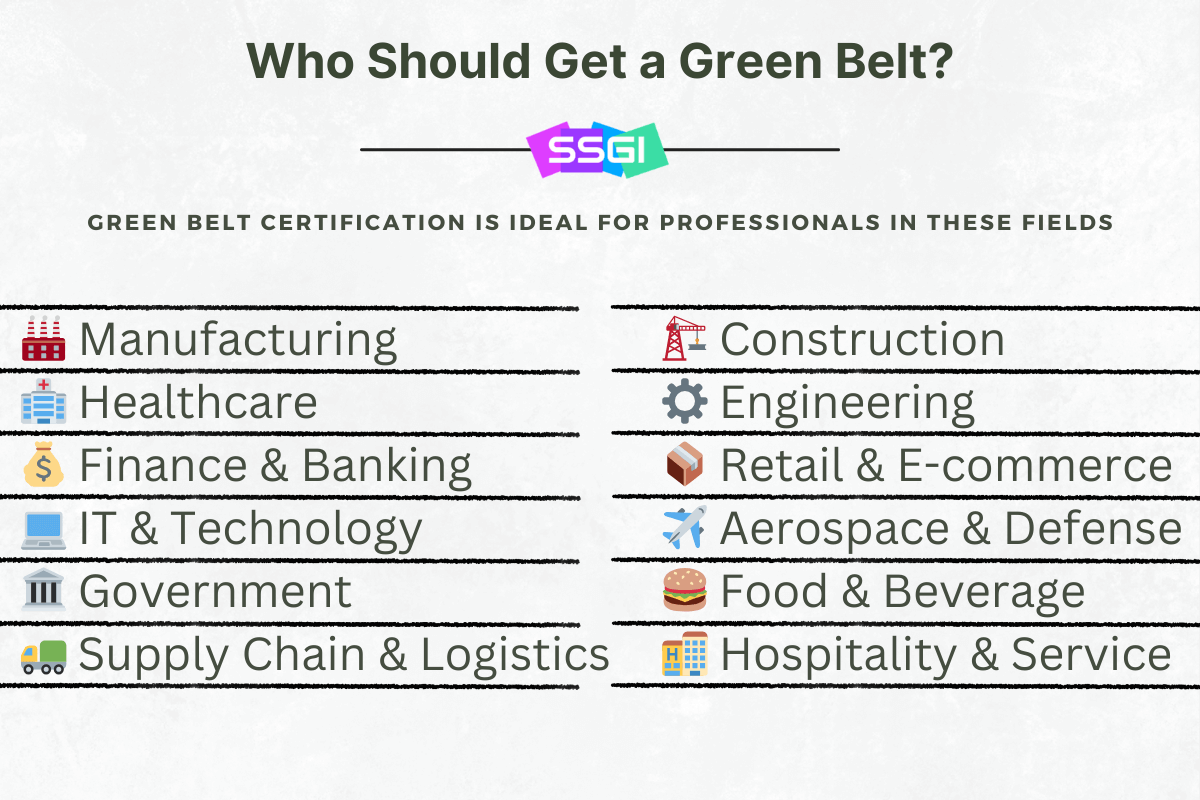
Green Belts are in demand across many industries. They support operational excellence initiatives and help teams achieve measurable results.
Common fields include:
Manufacturing – Streamlining workflows, reducing downtime
Healthcare – Improving patient flow and service quality
Government – Increasing efficiency and reducing lead times
Finance & Banking – Reducing errors and optimizing processes
Logistics & Supply Chain – Improving delivery speed and accuracy
Technology & IT Services – Enhancing reliability and reducing defects
Green Belts bring structure, data-driven thinking, and problem-solving skills to any environment where performance matters.
Who Should Get a Green Belt Certification?
A Green Belt is ideal for:
Professionals in operations, quality, or project management
Analysts, engineers, supervisors, and team leads
Individuals seeking career advancement
Anyone who wants to lead process improvement initiatives
- Professionals who have a Yellow Belt certification
Professionals preparing for Black Belt certification
No prior Lean Six Sigma experience is required—only a desire to improve processes and drive results.
How to Get Certified as a Six Sigma Green Belt
Getting certified is simple and can be completed fully online. Most programs, including SSGI’s, require no prerequisites and allow you to learn at your own pace.
What You Get With SSGI Certification
Comprehensive online training
Final exam included (no extra fees)
Downloadable templates, study guides, and case studies
Digital certification upon completion
Program developed by Dr. Barry Shore
Lifetime certification (no renewal required)
How the Certification Process Works
Enroll online through our secure platform
Begin training immediately (self-paced or live options)
Complete course modules and review case studies
Pass the certification exam (included; unlimited attempts)
Download your official certificate
Prerequisites
No prior Six Sigma certifications are required. Basic familiarity with business operations or quality concepts is helpful but not necessary.
Training Duration
Most learners complete the Green Belt program in 2 to 5 weeks, depending on availability. You have lifetime access to all course materials.
Check out our: Six Sigma certification guide
Green Belt Curriculum Overview
Green Belt training focuses on:
- Lean Six Sigma methodology
DMAIC methodology (Define, Measure, Analyze, Improve, Control)
Root cause analysis
Statistical and analytical tools
Process mapping and problem-solving
Hands-on case studies
Benefits of Earning a Green Belt Certification
A Green Belt delivers measurable value for your career and your organization.

1. Career Advancement
Many employers require or prefer Green Belts for leadership roles in operations, project management, and continuous improvement.
2. Increased Salary Potential
Green Belt-certified professionals often earn significantly more than non-certified peers.
The average U.S. salary for Green Belts is roughly $85,000 per year.
3. In-Demand Skills
Green Belts master tools and techniques that apply across every major industry.
Green Belt vs Other Belt Levels
| Certification | Role & Responsibilities | Best For |
|---|---|---|
| Yellow Belt | Provides a basic understanding of Six Sigma; supports Green and Black Belt projects | Beginners and team members getting started with process improvement |
| Green Belt | Leads small to medium-sized projects; applies Six Sigma tools; analyzes data | Professionals who want to manage projects and improve processes |
| Black Belt | Leads large-scale projects; mentors Green Belts; drives high-impact change | Experienced professionals and leaders managing cross-functional teams |
Tip: Many professionals start with a Green Belt before advancing to Black Belt.
Check out our: Full Six Sigma Belt Guide
Why Choose SSGI for Your Green Belt Certification?
Trusted by 1,000+ global organizations
No expiration or renewal fees
Affordable, expert-led training
Backed by the Baldrige Foundation
- PMI ATP (Approved for PDUs)
Program developed by an award-winning professor

Is Green Belt Certification Worth It?
Yes, if you want to accelerate your career, increase your earning potential, and become a leader in process improvement. Green Belt certification provides practical skills that help you solve problems, lead change, and deliver measurable results in any industry.
Still deciding? Learn more to see if Six Sigma Certification is worth it →
Frequently Asked Green Belt Questions (FAQs)
What does a Six Sigma Green Belt do?
A Six Sigma Green Belt leads small to mid-sized process improvement projects using the DMAIC methodology. Green Belts collect and analyze data, identify root causes, reduce waste, and implement solutions that improve quality, cost, and cycle time. They typically work cross-functionally while maintaining their primary job role. For a full breakdown of responsibilities, see What Does a Six Sigma Green Belt Do?
Is a Six Sigma Green Belt certification recognized by employers?
Yes. Six Sigma Green Belt certification is widely recognized by employers across industries such as manufacturing, healthcare, finance, logistics, and technology. Organizations value Green Belts for their ability to solve problems, reduce defects, streamline workflows, and lead data-driven improvement projects. Certified professionals often receive preference for roles in operations, quality, project management, and continuous improvement. SSGI certifications are used by over 1,000 organizations including Tesla, Maersk, and Disney.
Do I need a Yellow Belt before taking a Green Belt?
No, most professionals with some experience will go straight to Green Belt.
How long does it take to get a green belt?
Most participants complete certification in 1–3 weeks with our self-paced format.
How difficult is the Green Belt exam?
Moderate difficulty, includes case studies & multiple-choice questions.
Can I upgrade to Black Belt later?
Yes. Many of our Green Belt graduates continue on to Black Belt with a discount.
Is a Green Belt worth it?
Absolutely. It boosts your skills, earning potential, and career opportunities.
Is Six Sigma Green Belt only for manufacturing?
No, Six Sigma is used in many industries beyond manufacturing. While it originally started in manufacturing, today’s Green Belt professionals work in healthcare, finance, IT, government, logistics, and many other fields to improve efficiency and reduce waste.
Will a Green Belt increase my salary?
Earning a Six Sigma Green Belt certification can significantly boost your earning potential. Professionals with Green Belt certification earn an average salary of $85,000 – $108,000 per year, depending on industry, experience, and location.
Many employers value Six Sigma-trained professionals because they bring process improvement skills, cost-saving strategies, and data-driven decision-making to their organizations. As a result, Green Belt certification can help you:
✅ Qualify for higher-paying roles in operations, quality management, and process improvement
✅ Increase your chances of promotion to leadership positions
✅ Stand out in a competitive job market, giving you an edge over non-certified candidates
While salary increases depend on your current role, experience, and industry, earning a Green Belt certification demonstrates expertise that is highly sought after by employers—making it a smart investment for career growth.
Is a Green Belt enough, or do I need a Black Belt?
Depends on your career goals—Green Belt is great for hands-on work, while Black Belt is for leadership roles.
Do employers recognize Six Sigma Green Belt certification?
Yes! Many top companies, including Amazon, Walmart, Tesla, and the U.S. Air Force, hire professionals with Six Sigma certifications. SSGI’s Green Belt is accredited and widely recognized, making it a valuable credential for career growth.
Are all Green Belt certifications the same?
Not at all. Not all Green Belt certifications hold the same value. Certifications from programs that offer no-name instructor training or are based overseas often lack industry recognition and may not carry the same credibility as those from well-established, North America-based providers.
With SSGI, you are earning a certification from a fully accredited institution, recognized for its partnerships with the U.S. Department of Commerce, the Project Management Institute (PMI), and leading business schools. These affiliations ensure your certification is trusted by employers and valued in the job market.