
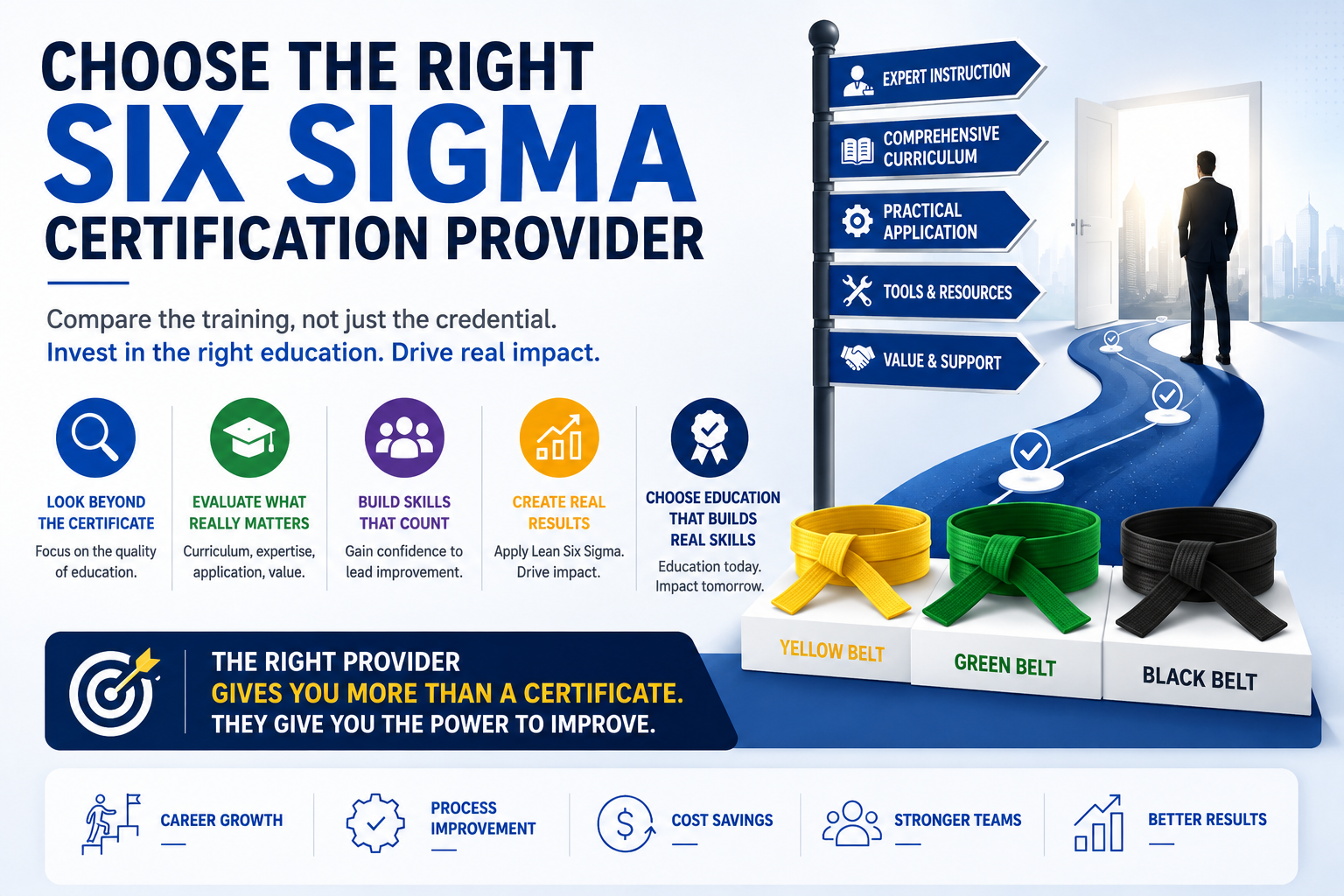
At first glance, many certification programs appear similar. Most offer Yellow Belt, Green Belt, and Black Belt certifications and promote online learning or internationally recognized credentials. However, the learning experience behind those certifications can vary significantly.
Two professionals may both earn a Green Belt, yet one finishes confident enough to lead improvement projects while the other leaves with little more than a certificate.
This guide explains the questions you should ask before enrolling in any Six Sigma certification program, helping you compare providers based on the quality of the education rather than marketing claims.
If you are still learning how the certification process works, start with our step-by-step guide on how to get Six Sigma certified.
What matters most?
👤 Course Developer 📚 Curriculum 🛠 Practical Application 📖 Learning Resources ⭐ Graduate Outcomes
Why Choosing the Right Provider Matters
Many people assume that every Six Sigma certification teaches essentially the same material.
In reality, providers differ in areas such as curriculum depth, instructor expertise, practical application, learning resources, and overall student experience.
The certificate itself is only one part of the equation.
The real value comes from what you’re able to do after completing the training.
A high-quality provider helps you develop practical problem-solving skills that you can apply immediately in your organization. A weaker program may prepare you to pass an exam without building the confidence needed to lead real improvement efforts.
If you are still deciding whether certification is the right investment for your career, read our guide on whether Six Sigma certification is worth it.
How to Evaluate a Six Sigma Certification Provider
There are dozens of organizations offering Six Sigma certification, and at first glance many of them appear very similar. Most offer the same belt levels, similar marketing claims, and professional-looking certificates.
The challenge is that certifications with the same name can provide very different learning experiences.
Rather than asking “Which provider is the best?”, ask “Which provider will best prepare me to improve real processes and solve real business problems?”
The following questions will help you compare providers objectively, regardless of which organization you’re considering.
1. Who Developed the Curriculum?
One of the first questions you should ask is:
Who actually created this course?
Some providers clearly identify the instructor or curriculum developer, while others never mention who wrote the training.
Look for programs developed by professionals with substantial experience teaching and applying Lean Six Sigma in real organizations.
Ask yourself:
- Is the curriculum created by a recognized expert?
- Does the instructor have years of practical and teaching experience?
- Can you easily learn about their background?
Knowing who developed the course gives you valuable insight into the quality of the education you’re about to receive.
Buyer Tip: If a provider doesn’t clearly identify who developed the curriculum, ask. Knowing the instructor’s background can tell you a great deal about the depth and quality of the training.
2. Does the Training Teach Real-World Application?
Six Sigma isn’t simply about memorizing definitions.
It’s about improving real processes.
Before enrolling, open the course outline.
Ask yourself:
- Does the training include real case studies?
- Are there worked examples?
- Will I practice solving realistic business problems?
- Does it explain why tools are used instead of simply defining them?
Programs that emphasize practical application generally prepare professionals much better than courses focused primarily on exam preparation.
3. How Comprehensive Is the Curriculum?
Not all Green Belts or Black Belts cover the same material.
Compare the curriculum carefully.
Ask questions like:
- Does the course progress logically from foundational concepts to advanced topics?
- Does it cover Lean principles alongside Six Sigma tools?
- Are statistical concepts explained clearly?
- Does the training show how the tools work together during an improvement project?
The goal should be understanding the methodology, not simply recognizing terminology.
Buyer Tip: Before enrolling, download or review the course outline. A detailed syllabus often reveals much more about a program than its marketing page.
4. Is the Goal to Build Skills or Simply Pass an Exam?
Some certification programs are designed primarily to help students pass an exam.
Others are designed to help professionals solve problems.
While passing the certification exam is important, ask yourself what happens after the exam.
Will you feel prepared to:
- identify root causes
- analyze data
- improve processes
- lead projects
- communicate improvement recommendations
Employers ultimately value the ability to improve performance more than the ability to answer multiple-choice questions.
5. Does the Program Include Practical Resources?
Learning doesn’t stop when the course ends.
Many professionals continue using templates, checklists, calculators, and reference materials throughout their careers.
Ask whether the provider includes resources such as:
- project templates
- improvement tools
- downloadable references
- practical worksheets
- implementation guides
These resources often become just as valuable as the certification itself.
6. What Is Included in the Price?
Certification pricing can vary considerably.
Before comparing costs, understand exactly what you’re paying for.
Questions to ask include:
- Is training included?
- Is the certification exam included?
- Are retakes included?
- Are there renewal fees?
- Is lifetime access included?
- Will I receive both training and certification?
Comparing total value is usually more meaningful than comparing the advertised price alone.
Requirements can also vary by provider, particularly around work experience, exams, and improvement projects. Review our guide to Six Sigma certification requirements before enrolling.
7. Does the Certification Need to Be Renewed?
Not every certification follows the same renewal model.
Before enrolling, ask:
- Does the certification expire?
- Are continuing education requirements required?
- Are renewal fees charged?
- What happens if I don’t renew?
Understanding these policies upfront can prevent unexpected costs later.
8. Is the Learning Format Right for You?
Some professionals prefer instructor-led training.
Others need the flexibility of self-paced online learning.
Neither approach is automatically better.
Instead, consider:
- your schedule
- preferred learning style
- employer requirements
- desired completion timeline
Choosing the format that fits your situation often leads to a better learning experien
9. What Do Previous Students Say?
One of the best ways to evaluate a provider is by looking beyond marketing materials.
Read reviews.
Look for student testimonials.
Browse LinkedIn posts from graduates.
Ask yourself:
- Are students talking about applying what they learned?
- Do they mention career growth?
- Do they discuss real projects?
- Are they recommending the training to others?
Consistent positive experiences often tell you much more than promotional claims.
10. Will This Program Prepare You for What’s Next?
Certification shouldn’t be viewed as the finish line.
It should prepare you for your next opportunity.
Whether that’s:
- moving from Yellow Belt to Green Belt
- leading larger projects
- pursuing Black Belt
- advancing your career
Choose a provider that builds lasting skills rather than simply helping you earn your next certificate.
To understand how each certification level fits into the broader pathway, explore our complete guide to Six Sigma belt levels.
Buyer Tip: Don’t compare providers based only on the certificate you’ll receive. Compare what you’ll actually know and be able to do after completing the training.
Common Mistakes When Choosing a Six Sigma Provider
Many professionals unintentionally evaluate certification providers using criteria that have little to do with the quality of the education they will receive. Here are some of the most common mistakes to avoid.
Common Mistakes to Avoid
Choosing the lowest price without comparing the quality and depth of the training.
Assuming every provider teaches the same curriculum.
Focusing only on the certificate instead of the skills you will develop.
Judging a program mainly by exam difficulty or pass requirements.
Ignoring who developed the curriculum and whether their experience is verifiable.
Comparing marketing claims without reviewing the course outline, policies, and graduate feedback.
A better approach: Compare the complete learning experience and ask which provider is most likely to prepare you to apply Lean Six Sigma successfully in the workplace.
Many buyers unintentionally compare providers using criteria that have little to do with the quality of the education they will receive.
Six Sigma Provider Evaluation Checklist
Before enrolling, use this checklist as a final review. A provider does not need to look identical to every other option, but it should be transparent about who developed the training, what you will learn, what is included, and how the program prepares you to apply Lean Six Sigma in the workplace.
Final Review
Before You Choose a Provider
Check each item only after confirming it through the provider’s website, curriculum, policies, or graduate feedback.
Buyer Tip: The final question should carry the most weight. A certification may look impressive, but the real value comes from being able to apply the methodology with confidence after the course is complete.
Six Sigma Provider Comparison Worksheet
Use this worksheet to compare certification providers using the same criteria. Review each provider’s website, curriculum, pricing, and instructor information, then check the boxes that apply.
Avoid evaluating providers based only on price or the appearance of the certificate. The goal is to identify which program offers the strongest combination of expert-developed training, curriculum depth, practical application, transparency, and long-term value.
A comparison worksheet cannot identify one universally “best” provider because different learners have different schedules, budgets, and career goals. However, it can help you separate measurable program qualities from vague marketing claims.
Pay particular attention to the criteria that affect what you will actually learn. An inexpensive program may provide good value if it offers credible instruction and meaningful training. An expensive program is not automatically better if it provides little transparency about its curriculum, course developer, or practical application.
After completing the worksheet, ask yourself one final question:
Which provider is most likely to leave me confident enough to apply Lean Six Sigma in a real organization?
That answer is often more meaningful than comparing certificate designs, exam lengths, or promotional claims alone.
Once you understand how to evaluate a provider objectively, you can compare individual certification providers using those same criteria.
Choosing the Right Certification After Selecting a Provider
Once you’ve chosen a provider you trust, the next step is selecting the certification level that best matches your experience and career goals.
For many professionals, the biggest question becomes whether to start with a Yellow Belt or go directly to a Green Belt.
If you’re trying to decide, we’ve created a detailed comparison that explains the differences, who each certification is designed for, and how to determine which path is the best fit for your goals.
→ Read: Should You Get a Lean Six Sigma Yellow Belt or Green Belt?
Frequently Asked Questions About Choosing a Six Sigma Certification Provider
Choosing a Six Sigma certification provider involves more than comparing prices or certificate names. Below are answers to some of the most common questions professionals ask before enrolling in a certification program.
Does the certification provider matter?
Yes, but not always for the reasons people expect.
Many providers offer certifications with similar names, but the quality of the training can vary significantly. Rather than focusing only on the certificate itself, compare the curriculum, instructor expertise, practical application, learning resources, and overall educational experience. The provider you choose can influence how prepared you feel to apply Lean Six Sigma in real-world situations.
What should I look for in a Six Sigma certification provider?
Look for a provider that offers comprehensive training, experienced instructors, practical examples, real-world application, and transparent pricing. Before enrolling, review the course outline, understand what is included, and make sure the program teaches more than just how to pass an exam.
Can two people with the same Six Sigma certification have different skill levels?
Absolutely.
Two professionals may both earn a Green Belt or Black Belt, yet leave with very different levels of knowledge and confidence. The difference often comes down to the quality of the training they received, the depth of the curriculum, opportunities to apply the concepts, and the overall learning experience. A certification is valuable, but the skills developed during the training are what ultimately determine how effectively someone can improve processes and solve business problems.
Is the most expensive Six Sigma certification the best?
Not necessarily.
Price alone does not determine quality. Some lower-cost programs provide excellent education, while some expensive programs may focus primarily on certification rather than skill development. Compare the overall learning experience instead of assuming a higher price means better training.
Should I choose a provider based on the certification body?
The certification body is only one factor to consider.
A strong curriculum, experienced instructor, practical application, and comprehensive learning experience often have a greater impact on your long-term success than the name printed on the certificate.
Is online Six Sigma training respected by employers?
Yes.
Many employers recognize online Six Sigma certifications, particularly when the training is comprehensive and the professional can demonstrate how they apply Lean Six Sigma concepts in real business situations.
How can I tell if a Six Sigma course is high quality?
Start by looking at who developed the curriculum.
Many providers emphasize the certification itself but say very little about who created the training. Before enrolling, ask:
- Who developed this course?
- What is their experience teaching or applying Lean Six Sigma?
- Are they a recognized expert whose background you can verify?
Then review the course outline. A high-quality program should include real-world case studies, practical application exercises, comprehensive coverage of Lean Six Sigma tools, and resources that help you apply what you learn on the job.
Ultimately, the goal of a Six Sigma course isn’t simply to help you pass an exam. It should prepare you to solve real business problems with confidence.
Should I choose a provider that requires a project?
That depends on your goals.
Some professionals prefer programs that include a project because they provide practical experience while learning. Others choose to complete certification first and apply the methodology later in their own organization. What’s most important is that the training prepares you to successfully complete improvement projects when the opportunity arises.
Can I compare different Six Sigma providers objectively?
Yes.
Instead of comparing marketing claims, compare measurable factors such as curriculum depth, instructor qualifications, practical application, learning resources, certification requirements, pricing, and graduate outcomes. Evaluating providers using consistent criteria makes it much easier to identify which program best fits your goals.
Which Six Sigma certification should I choose after selecting a provider?
Once you’ve selected a provider, the next step is choosing the certification level that matches your experience and career goals.
For most professionals, that means deciding whether to begin with a Lean Six Sigma Yellow Belt or go directly to a Lean Six Sigma Green Belt.
Read our guide:
Should You Get a Lean Six Sigma Yellow Belt or Green Belt?