
What Is Operational Excellence (OpEx)? A Simple Explanation

Operational Excellence (OpEx) is a management philosophy focused on continuously improving processes, reducing waste, and delivering consistent value to customers. Operational Excellence is used by leading organizations worldwide to improve performance, reduce costs, and sustain long-term growth.

Organizations achieve operational excellence by developing strong leadership behaviors, structured problem-solving methods, and a culture where employees at every level work to improve performance.

Operational Excellence is commonly supported by methodologies such as Lean Six Sigma and continuous improvement systems, which provide the tools and structure needed to drive measurable results.

At its core, Operational Excellence is about building capability across people, processes, and leadership to sustain long-term performance improvement.
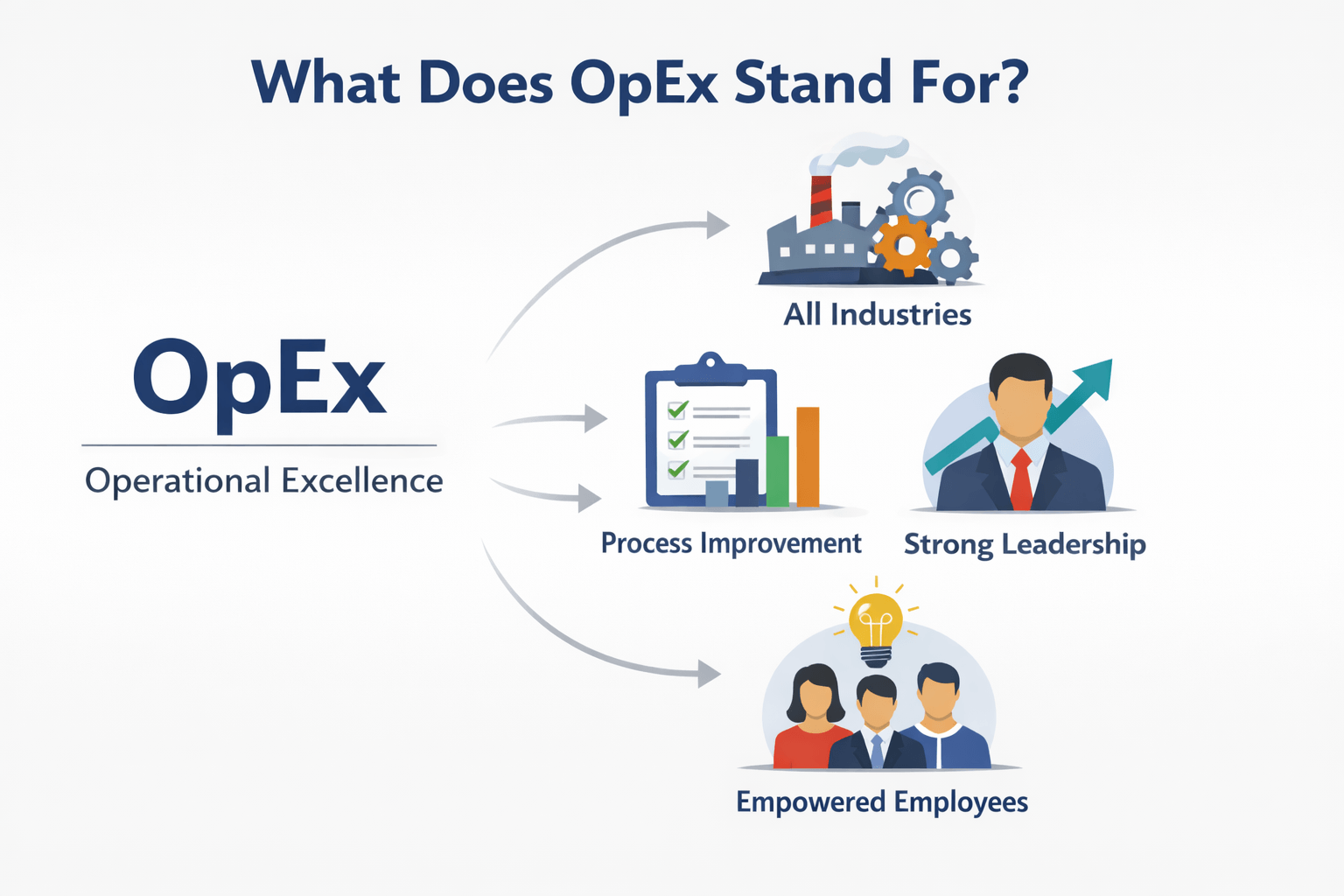

Operational Excellence (OpEx) is a management approach focused on improving processes, reducing waste, and building a culture of continuous improvement to deliver consistent value and long-term performance.

A Simple Way to Think About OpEx

Operational Excellence = Leadership + Process Improvement + Culture

Leadership Leaders reinforce improvement behaviors and remove obstacles
+
Structured Problem-Solving Teams use Lean, Six Sigma, and continuous improvement methods
+
Culture Employees at every level work to improve performance over time

WHAT DOES OPEX STAND FOR?

OpEx stands for Operational Excellence.

It refers to a structured approach to improving performance across an organization by increasing efficiency, reducing waste, and delivering consistent value to customers.

Organizations pursuing Operational Excellence focus on:

• improving efficiency and process performance
• reducing errors, variation, and waste
• developing strong leadership and accountability
• empowering employees to solve problems at the source
• delivering consistent, measurable results

Operational Excellence is not a single tool or certification. It is a long-term management system that shapes how organizations operate, improve, and sustain performance over time.

What is Operational Excellence OPEX?
In practice, many organizations build these capabilities through structured training in Six Sigma certification programs, Lean methodologies, and leadership development programs.

Why Operational Excellence Matters

Organizations pursue Operational Excellence because it drives both immediate performance improvements and long-term competitive advantage.

Companies that successfully build Operational Excellence capabilities typically achieve:

• higher productivity and process efficiency
• reduced operational costs
• fewer defects, errors, and rework
• faster cycle times and improved throughput
• higher customer satisfaction
• stronger employee engagement and accountability

Rather than relying on short-term improvements, Operational Excellence focuses on building systems and behaviors that consistently produce better results over time.

For this reason, many organizations embed Operational Excellence into their broader business strategy as a foundation for sustainable performance.

These outcomes are what make Operational Excellence a priority across industries.

Why Organizations Invest in Operational Excellence

Improved productivity
Reduced operational costs
Fewer defects and errors
Faster cycle times
Higher customer satisfaction
Stronger employee engagement

Operational Excellence vs Continuous Improvement

Operational Excellence and continuous improvement are closely related, but they are not exactly the same.

Continuous Improvement focuses on regularly identifying and implementing small improvements to processes.

Operational Excellence is the broader system that enables continuous improvement to happen consistently across an organization.

Continuous improvement is one component of Operational Excellence, but Operational Excellence also includes leadership behaviors, organizational culture, performance systems, and structured problem-solving frameworks.

In other words:

Continuous improvement improves processes.
Operational Excellence builds an organization that improves continuously.

Continuous Improvement

Improves processes regularly

  • Focuses on ongoing small improvements
  • Targets process-level changes
  • Helps teams solve recurring issues

Operational Excellence

Builds an organization that improves continuously

  • Includes leadership behaviors and culture
  • Supports sustainable performance systems
  • Creates consistent improvement across the organization

Operational Excellence vs Lean Six Sigma

Lean Six Sigma is one of the most widely used methodologies for achieving Operational Excellence.

Lean focuses on eliminating waste and improving process flow, while Six Sigma focuses on reducing variation and improving quality using data analysis.

Operational Excellence often combines multiple methodologies, including:

• Lean principles
• Six Sigma problem-solving methods
• continuous improvement practices
• leadership development
• performance management systems

Lean Six Sigma tools help organizations improve processes, but Operational Excellence ensures those improvements become sustainable and repeatable.

Learn more about Lean Six Sigma methodology.

Core Principles of Operational Excellence

Although different organizations may define Operational Excellence slightly differently, most successful OpEx systems share several core principles.

Customer Focus

Design processes that consistently deliver value to customers.

Process Thinking

View work as interconnected processes rather than isolated tasks.

Data-Driven Decisions

Use measurable data instead of assumptions or opinions.

Continuous Improvement

Improve regularly instead of waiting for major problems to appear.

Leadership Engagement

Leaders support improvement efforts and reinforce the right behaviors.

Employee Empowerment

Encourage the people closest to the work to identify problems and improve them.

Together, these principles create an environment where improvement becomes part of everyday operations.

What Is an Operational Excellence Culture?

An Operational Excellence culture is an environment where employees consistently look for ways to improve processes, solve problems, and deliver better results.

In organizations with strong Operational Excellence cultures:

• improvement is part of daily work
• employees feel comfortable raising problems
• leaders encourage experimentation and learning
• teams collaborate across departments
• quality and efficiency are shared responsibilities

Operational Excellence cultures are built through consistent leadership behavior, clear expectations, and structured improvement systems.

Tools alone do not create Operational Excellence. Culture determines whether improvement efforts succeed or fail.

Why Many Operational Excellence Programs Fail

Many organizations attempt to implement Lean or Six Sigma initiatives but fail to achieve lasting results.

In most cases, the problem is not the methodology itself but the way it is implemented.

Common reasons Operational Excellence programs fail include:

Lack of Leadership Alignment

Without visible leadership support, improvement efforts lose momentum quickly.

Treating Improvement as a Project

Operational Excellence must become part of management, not a short-term initiative.

Limited Training

Training only a few specialists does not build an improvement culture.

Short-Term Expectations

Organizations often abandon efforts too early when they expect immediate results.

Blaming Individuals

Focusing on blame instead of systems makes employees reluctant to surface problems.

Successful Operational Excellence programs address both technical tools and organizational behaviors.

How to Implement Operational Excellence in an Organization

Implementing Operational Excellence requires more than introducing Lean tools or launching a few improvement projects. It involves building the leadership, systems, and behaviors needed to support continuous improvement over time.

Organizations typically implement Operational Excellence by focusing on several key steps:


Align Leadership Around Clear Goals

Operational Excellence starts with leadership commitment. Leaders must define priorities, reinforce expectations, and consistently support improvement efforts across the organization.


Train Employees in Structured Problem-Solving

Employees need practical training in methods such as Lean, Six Sigma, and continuous improvement so they can identify issues, analyze root causes, and improve processes effectively.


Standardize Processes and Measure Performance

Organizations need clear process standards, performance metrics, and accountability systems to make improvement measurable and repeatable.


Build a Culture of Daily Improvement

Operational Excellence becomes sustainable when improvement is part of everyday work, not an occasional initiative. Teams should be encouraged to surface problems, test solutions, and continuously refine processes.


Support Improvement Across Functions

Many operational problems cross departmental boundaries. Effective implementation requires collaboration across teams so improvements are aligned with broader business goals.


Reinforce Behaviors That Sustain Results

Long-term success depends on leadership behaviors, employee engagement, and systems that make continuous improvement part of how the organization operates.

The Key Behaviors of Operational Excellence Organizations

High-performing organizations typically share several behavioral characteristics.

1. LEADERS GO TO THE GEMBA

Real problems are visible only where the work happens.
Leadership presence reduces fear, increases alignment, and builds trust.

2. MISTAKES ARE TREATED AS DATA, NOT BLAME

Instead of “Who messed up?”, the mindset becomes:
“What allowed this mistake to happen?”

3. TEAMS SOLVE PROBLEMS TOGETHER

Quality, Operations, Maintenance, Engineering, Supply Chain, HR — all functions share ownership.

4. STANDARDS ARE FOLLOWED AND IMPROVED

Strong OpEx cultures maintain standards but also empower workers to challenge and enhance them.

5. TRANSPARENCY IS NORMAL, NOT RISKY

People report issues early because it’s safe to do so.

6. IMPROVEMENT IS DAILY, NOT OCCASIONAL

OpEx isn’t a ceremony, event, or project — it’s a habit.

These behaviors help transform improvement efforts from isolated projects into sustainable organizational habits.

Examples of Operational Excellence across Industries

Operational Excellence can be applied across many industries.

Manufacturing

Improve production efficiency, reduce defects, and optimize supply chain performance.

Healthcare

Streamline patient flow, reduce errors, and improve quality of care and outcomes.

Technology

Enhance development processes, reduce cycle times, and improve product delivery.

Logistics & Supply Chain

Optimize inventory, improve delivery performance, and reduce operational waste.

These examples demonstrate how Operational Excellence improves performance across diverse industries.

How Organizations Build Operational Excellence

Building Operational Excellence requires a combination of leadership commitment, employee engagement, and structured problem-solving systems.

Key components include:

  • Developing leadership capability in process improvement
  • Training employees in structured problem-solving methods
  • Establishing performance measurement and accountability systems
  • Driving collaboration across teams and functions
  • Embedding continuous improvement into daily operations

Organizations typically support these efforts through structured training in Lean, Six Sigma, and continuous improvement methodologies.

Building Capability

How Capability Is Built Over Time

Operational Excellence is built progressively by developing capability across individuals, teams, and leadership.

1

Yellow Belt

Build foundational process improvement and problem-solving skills

2

Green Belt

Lead projects and apply data-driven analysis to improve performance

3

Black Belt

Drive complex, cross-functional improvement initiatives at scale

4

Leadership Training

Embed a culture of continuous improvement across the organization

Operational Excellence and Lean Six Sigma Training

Training plays an important role in helping organizations develop the skills required for Operational Excellence.

Structured training programs teach employees how to:

• analyze processes
• identify root causes of problems
• use data to guide decision making
• implement sustainable improvements

At SSGI, organizations often develop Operational Excellence capability through a structured training pathway that includes:

Yellow Belt certification
Green Belt certification
Black Belt certification
Operational Excellence (OPEX-L) certification

These programs help build the technical and leadership capabilities required to sustain continuous improvement.

FAQs


WHAT IS OPERATIONAL EXCELLENCE IN SIMPLE TERMS?

Operational Excellence is a management philosophy focused on continuously improving processes, reducing waste, and delivering consistent value to customers.

WHAT IS THE GOAL OF OPERATIONAL EXCELLENCE?

The goal is to create systems that allow organizations to consistently improve performance, efficiency, quality, and customer satisfaction.

WHAT IS THE DIFFERENCE BETWEEN OPERATIONAL EXCELLENCE AND LEAN SIX SIGMA?

Lean Six Sigma is a methodology used to improve processes by reducing waste and variation. Operational Excellence is a broader management system that includes Lean Six Sigma along with leadership behaviors, culture, and continuous improvement practices.

In other words, Lean Six Sigma is one of the key tools used to achieve Operational Excellence, but Operational Excellence extends beyond tools to how an organization operates and improves over time.

WHAT INDUSTRIES USE OPERATIONAL EXCELLENCE?

Operational Excellence is used in many industries, including manufacturing, healthcare, finance, logistics, technology, and government.

HOW DO ORGANIZATIONS IMPLEMENT OPERATIONAL EXCELLENCE?

Organizations implement Operational Excellence by developing leadership capability, training employees in improvement methodologies, and building systems that encourage continuous improvement.

WHAT ARE THE KEY PRINCIPLES OF OPERATIONAL EXCELLENCE?

Core principles include customer focus, process thinking, data-driven decision making, continuous improvement, leadership engagement, and employee empowerment.

WHY IS OPERATIONAL EXCELLENCE IMPORTANT?

Operational Excellence helps organizations improve productivity, reduce costs, increase quality, and build long-term competitive advantage.