
SIX SIGMA CERTIFICATION IN IT & TECHNOLOGY: Benefits, Jobs & Career Impact
In IT and technology, even small process issues can lead to system downtime, software defects, and costly project delays. Six Sigma equips professionals with data-driven tools to improve quality, reduce errors, and optimize performance — across development, operations, and support environments.
At SSGI, our online Six Sigma Certification programs, developed by McGraw-Hill award-winning professor Dr. Barry Shore, help IT and technology professionals streamline workflows, enhance reliability, eliminate waste, and drive continuous improvement in areas such as software development, IT service management, and digital transformation.

HOW SIX SIGMA TRANSFORMS IT & TECHNOLOGY OPERATIONS
Across the IT and technology landscape, organizations use Lean Six Sigma to eliminate inefficiencies, reduce errors, and improve performance at every stage — from software development and testing to deployment and ongoing support. By combining data-driven analysis with continuous improvement principles, teams can identify root causes, streamline workflows, and enhance system reliability.
From IT project management and DevOps to cybersecurity and service delivery, Six Sigma empowers organizations to improve uptime, increase user satisfaction, and make smarter, data-backed decisions. The result is a culture of operational excellence that drives innovation, agility, and long-term success in a fast-evolving digital environment.

Why Choose SSGI for IT & Technology Certification
Industry-Trusted, Expert-Led Training
At SSGI, we specialize in professional certifications designed for real-world application. Our programs are trusted by over 1,000 leading corporations—including Tesla, Walmart, Disney, and GE—and are used to train teams at every level of the IT and Technology process.
Best Value for Industry-Leading Training
SSGI provides all-inclusive pricing with no surprise fees for exams, retakes, or certification renewals. Plus, our training is developed by Dr. Barry Shore, a McGraw-Hill award-winning professor.
Accredited by PMI, SHRM, and CPD
SSGI certifications meet the highest industry standards, ensuring global recognition for professionals in IT & technology sectors. Also earn professional credits like PDUs and CEUs.
Trusted by IT & Technology Leaders
Our clients include some of the biggest names in the IT & Technology sector such as Amazon, Apple, Cisco, and AMD. SSGI’s Lean Six Sigma certifications are trusted and recognized across the technology industry for developing leaders in quality and operational excellence.
Certifications That Never Expire
Once certified with SSGI, your credential lasts for life—no renewal fees, no expiration, and no hidden costs.
100,000+ Certified Professionals & $500M in Cost Savings
SSGI graduates have successfully led cost-cutting, process optimization, and efficiency-improving initiatives, generating over $500M in savings for organizations worldwide.

Prof. Barry Shore PhD | SSGI Founder
Dr. Barry Shore | Expert Instructor
Dr. Barry Shore, a globally recognized expert in operations management, brings over 40 years of experience to Lean Six Sigma training. As a McGraw-Hill award-winning author and professor emeritus, his groundbreaking work has empowered professionals from Fortune 500 companies, government agencies, and leading organizations worldwide.
Industry Recognized Accreditations | Baldrige Foundation Partner | #1 in Process Improvement for the IT/Technology Industry

SSGI is trusted by leading IT organizations around the world.






Top Reasons Why You Should Get Six Sigma Certification in IT & Technology
Increase Career & Salary Potential
In the IT and technology industry, Six Sigma certification is one of the most valuable credentials for professionals focused on quality, efficiency, and performance optimization. Certified Six Sigma professionals in IT roles earn $95K+ on average and are trusted to lead projects that reduce errors, improve service delivery, and enhance reliability across complex digital systems.
By applying Six Sigma principles, IT and technology leaders drive measurable improvements in software quality, system uptime, and customer experience — making them indispensable assets in today’s data-driven, innovation-focused organizations.
Improve Quality
Organizations in the IT and technology sector rely on precision, speed, and reliability to deliver seamless digital experiences and support business-critical operations. Six Sigma methodologies help eliminate process inefficiencies, optimize workflows, and ensure quality and consistency are built into every stage of the technology lifecycle.
Lean Six Sigma initiatives in IT and technology have helped organizations reduce downtime, minimize rework, lower operational costs, and achieve excellence across the entire ecosystem — from software development and infrastructure management to service delivery and customer support.
Cut Cost & Reduce Waste
In IT and technology, inefficiencies directly impact system performance, project timelines, and user satisfaction. Six Sigma’s structured approach to process improvement helps identify root causes of errors and bottlenecks, reduce variation across workflows, and ensure every process contributes to greater efficiency, speed, and overall service reliability.
Strengthen Leadership & Culture
Organizations that implement Six Sigma in IT and technology foster a data-driven, problem-solving culture across every level of their workforce. This methodology empowers teams to identify the root causes of performance issues, make evidence-based decisions, and continuously optimize workflows across software development, infrastructure management, and IT service delivery — resulting in greater efficiency, reduced costs, and sustained competitiveness in a fast-evolving digital landscape.
Improve Customer Satisfaction
IT and technology organizations manage complex systems, applications, and data environments every day, making operational efficiency essential for performance, security, and user satisfaction. Six Sigma strengthens IT systems by reducing process variation, improving project delivery timelines, and ensuring consistent, high-quality performance — resulting in greater reliability, transparency, and trust among users, clients, and stakeholders.
SIX SIGMA CERTIFICATION IN IT & TECHNOLOGY: JOB OPPORTUNITIES & SALARY INSIGHTS
Six Sigma-certified professionals are in high demand across the IT and technology industry, where quality, efficiency, and system reliability directly impact organizational performance and customer experience. Companies in software development, IT services, cybersecurity, and cloud infrastructure actively seek experts who can streamline processes, reduce errors, and improve project delivery outcomes.
With Six Sigma certification, professionals gain the ability to analyze complex workflows, identify inefficiencies, and implement data-driven improvements — skills that are highly valued in roles such as IT project management, process improvement, DevOps, quality assurance, and IT service management (ITSM).
As an official Baldrige Foundation partner, the organization behind the Malcolm Baldrige National Quality Awardpresented annually by the President of the United States, SSGI aligns its certifications with the highest standards of process excellence.
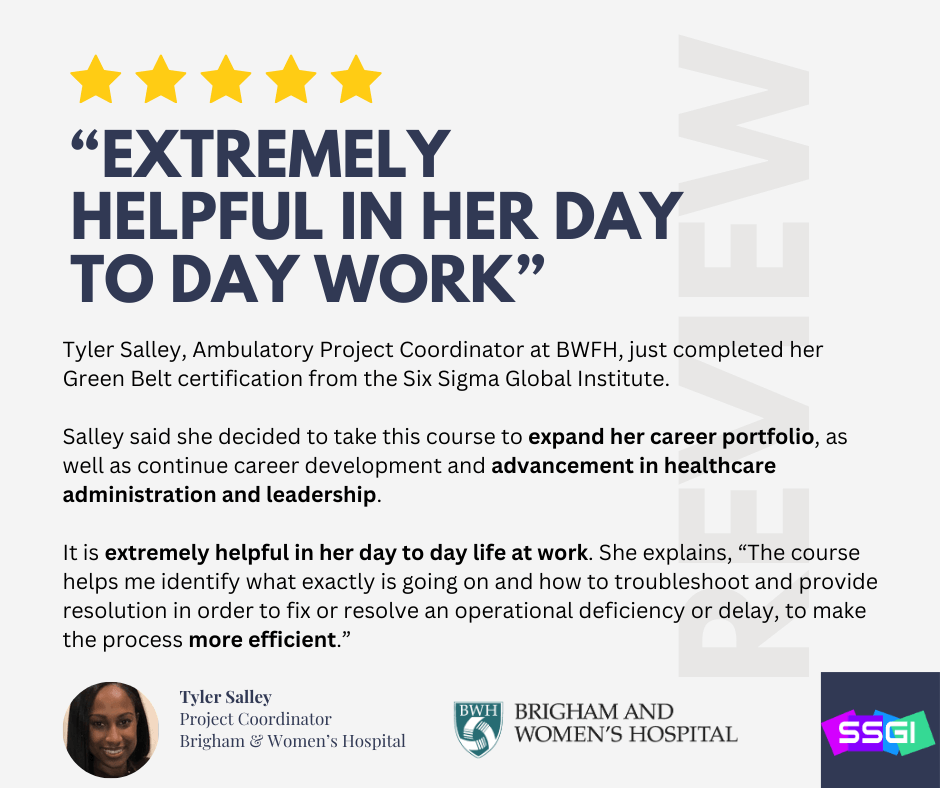
Our programs are trusted by leading organizations including Google, IBM, Dell, and Brigham and Women’s Hospital, as well as professionals across the global IT, software, and technology sectors.

Who Hires Six Sigma-Certified Professionals in IT & Technology?
Organizations across the IT and technology landscape actively recruit Six Sigma-certified professionals to lead quality, efficiency, and continuous improvement initiatives across digital systems and operations.
Software Development Companies:
Process optimization, defect reduction, and improved testing efficiency across the software development lifecycle.
IT Services & Managed Service Providers:
Incident management, response time improvement, and workflow standardization for consistent service delivery.
Technology Operations & Infrastructure Teams:
System uptime improvement, process automation, and performance optimization across networks and data centers.
Cybersecurity & Compliance Teams:
Root cause analysis for incident prevention, audit readiness, and quality assurance in data protection processes.
Cloud & SaaS Organizations:
Deployment efficiency, scalability improvements, and customer experience enhancement through continuous process refinement.
Overview of Six Sigma Certification in IT & Technology
Modern IT and technology environments operate in a fast-moving, innovation-driven world where efficiency, accuracy, and data-based decision-making are critical for success. Six Sigma certification equips professionals at all levels with the skills to identify process inefficiencies, reduce variation, and improve quality — essential capabilities for achieving operational excellence in IT and digital transformation.
At SSGI, we offer a comprehensive range of Lean Six Sigma certification programs that help organizations streamline processes, enhance reliability, and build a culture of continuous improvement across software development, IT operations, cybersecurity, and service management.
Our courses provide practical, industry-relevant training aligned with real-world challenges in technology — from reducing defects in software development and improving deployment workflows to increasing uptime and IT service quality across the enterprise.

Recommended Programs
Choose the Right Certification for Your IT & Technology Career
Many professionals in the IT and technology field pursue multiple Belt levels to gain a complete understanding of Lean Six Sigma methodologies and apply them to process improvement, quality assurance, and performance optimization initiatives.
Six Sigma certification in IT follows a tiered approach, similar to martial arts rankings, progressing from foundational knowledge to advanced leadership expertise. Each level is designed to help professionals strengthen their analytical, problem-solving, and decision-making skills — essential for improving efficiency, reducing errors, and driving reliability across software development, IT operations, and digital transformation projects.
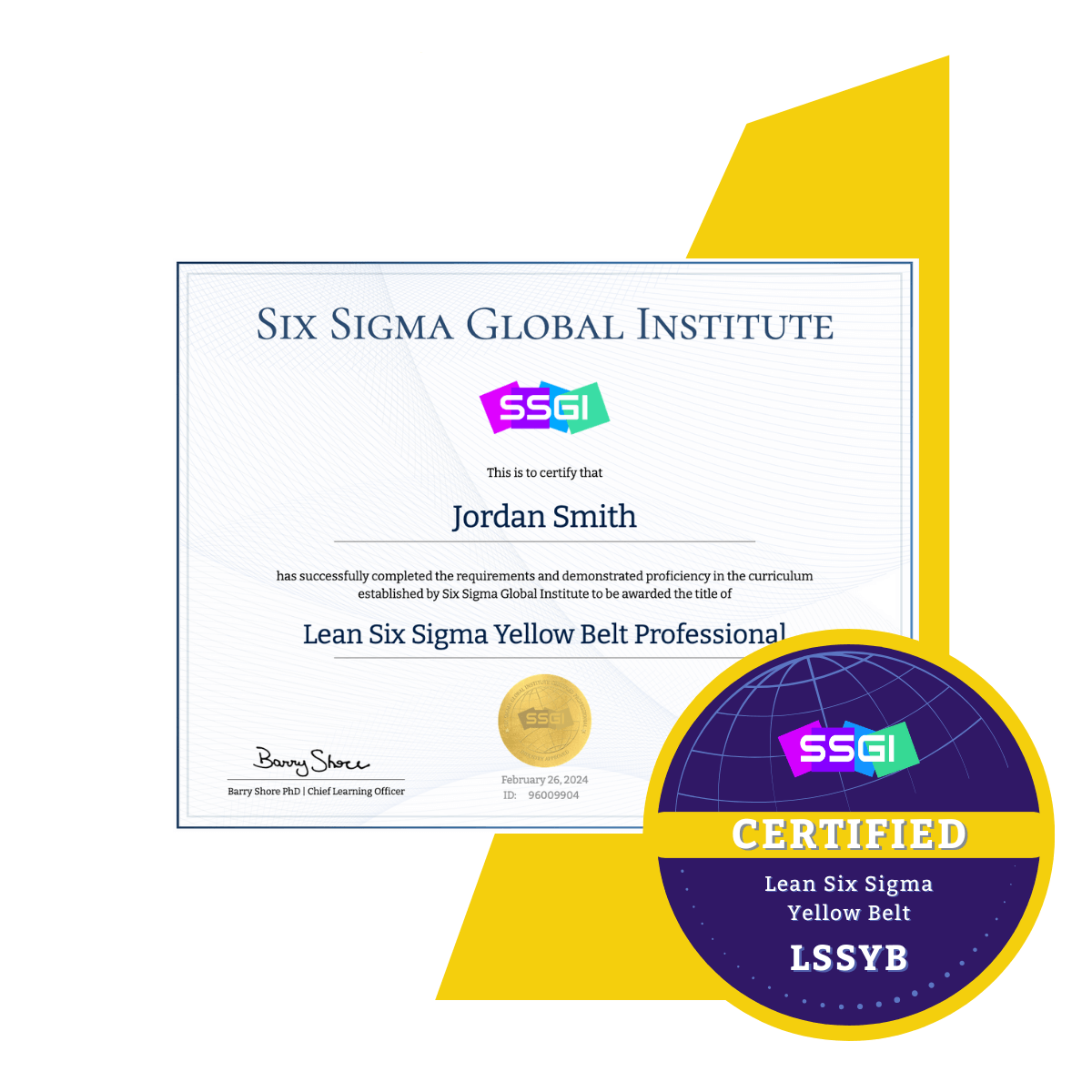
🟡 Yellow Belt – Ideal for beginners.
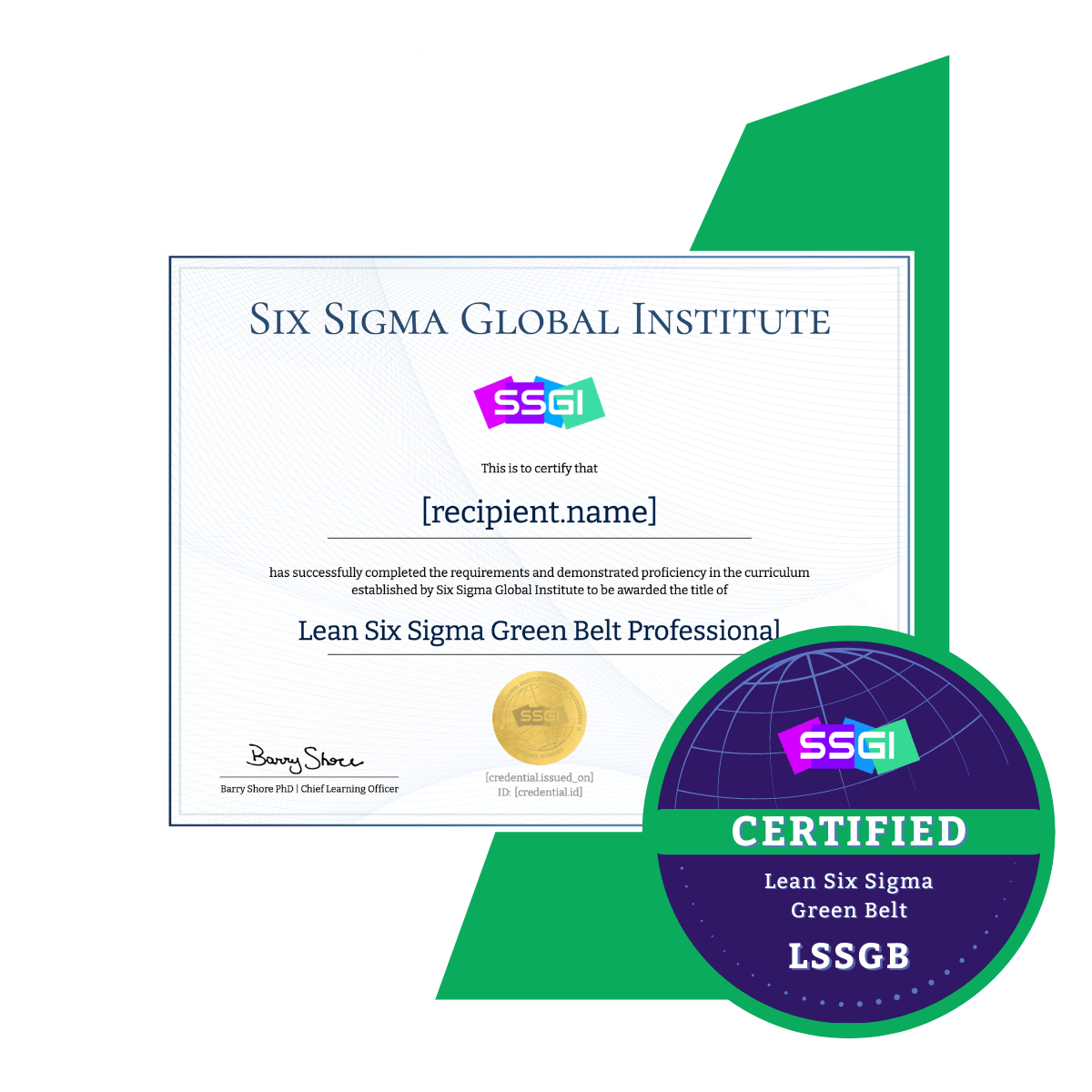
🟢 Green Belt – Designed for mid-level professionals.
⚫ Black Belt – For IT leaders.
🏆 Master Black Belt – The highest level, for experts.
Yellow Belt Training & Certification for IT & Technology Professionals
Best for: IT analysts, support specialists, QA testers, and team members involved in process improvement and service optimization within IT or technology functions.
Overview: The Yellow Belt certification provides foundational knowledge of Lean Six Sigma principles, enabling professionals to identify inefficiencies, reduce errors, and support process improvement across IT operations and technology workflows.
✅ Gain introductory training in Lean Six Sigma methodology.
✅ Learn to identify and eliminate waste in software development, IT support, and project workflows.
✅ Support Green and Black Belts in initiatives that improve quality, reliability, and system performance.
Green Belt Training & Certification for IT & Technology Professionals
Best for: IT project managers, business analysts, QA engineers, DevOps specialists, and mid-level professionals leading process improvement and quality initiatives in technology environments.
Overview: The Green Belt certification equips professionals to lead process improvement projects within IT and technology settings. Green Belts collaborate with Black Belts to implement data-driven solutions that reduce errors, enhance efficiency, and strengthen system reliability across digital operations.
✅ Learn how to apply Six Sigma methodologies in IT and software development processes.
✅ Gain hands-on skills in project management, data analysis, and process optimization.
✅ Eliminate bottlenecks, improve workflow speed, and enhance performance across development, operations, and service delivery functions.
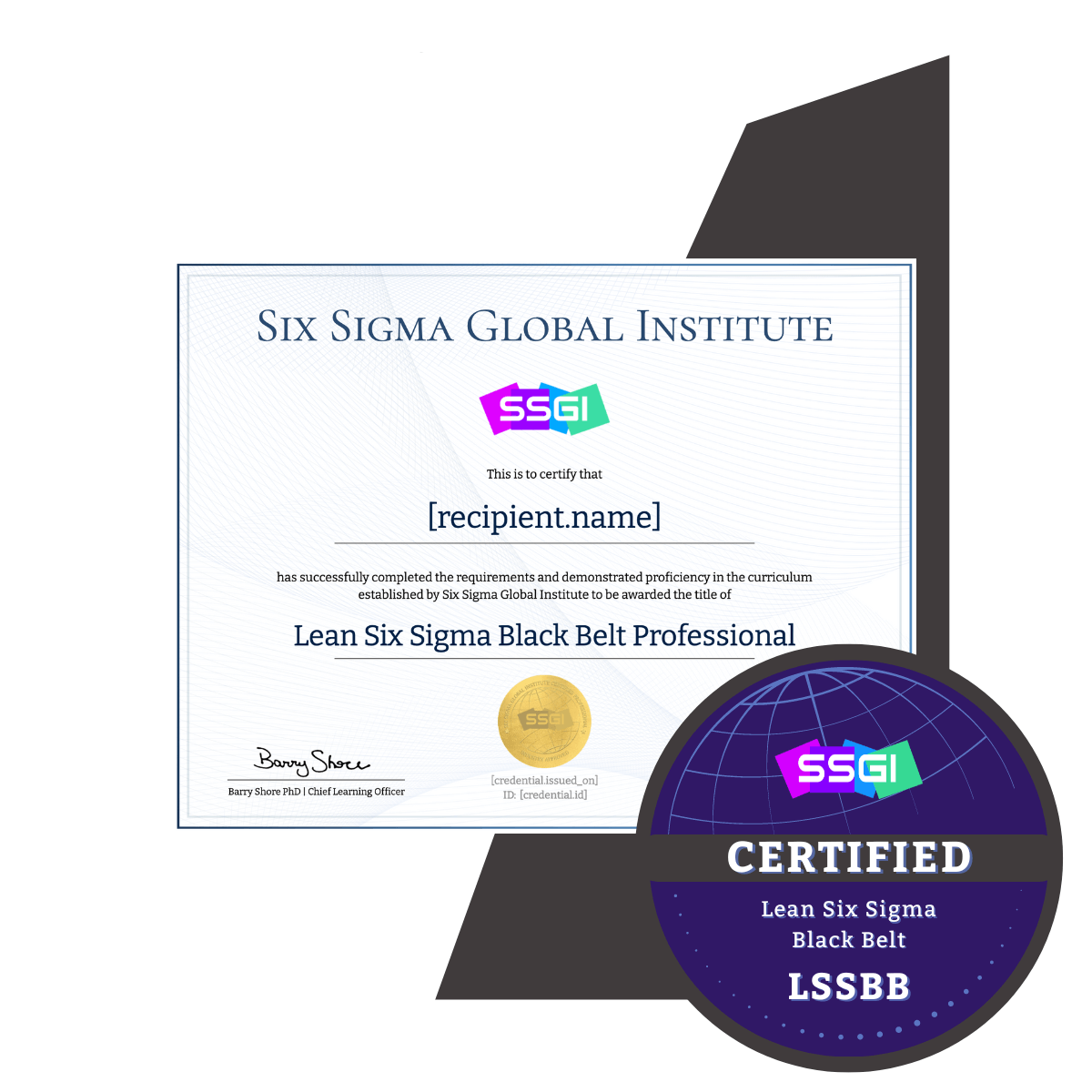
Black Belt Training & Certification for IT & Technology Professionals
Best for: Senior managers, IT directors, technology leaders, and executives responsible for driving efficiency, quality, and innovation across digital operations.
Overview: Black Belt-certified professionals lead large-scale process improvement and transformation initiatives across IT and technology organizations. The Black Belt certification is ideal for professionals seeking to enhance productivity, reduce errors, and strengthen performance through data-driven decision-making and strategic leadership.
✅ Master advanced problem-solving, data analysis, and leadership techniques.
✅ Lead cross-functional projects that improve quality, reduce downtime, and optimize end-to-end IT performance.
✅ Implement strategies to increase efficiency, streamline development and operations, and drive measurable business impact across technology environments.
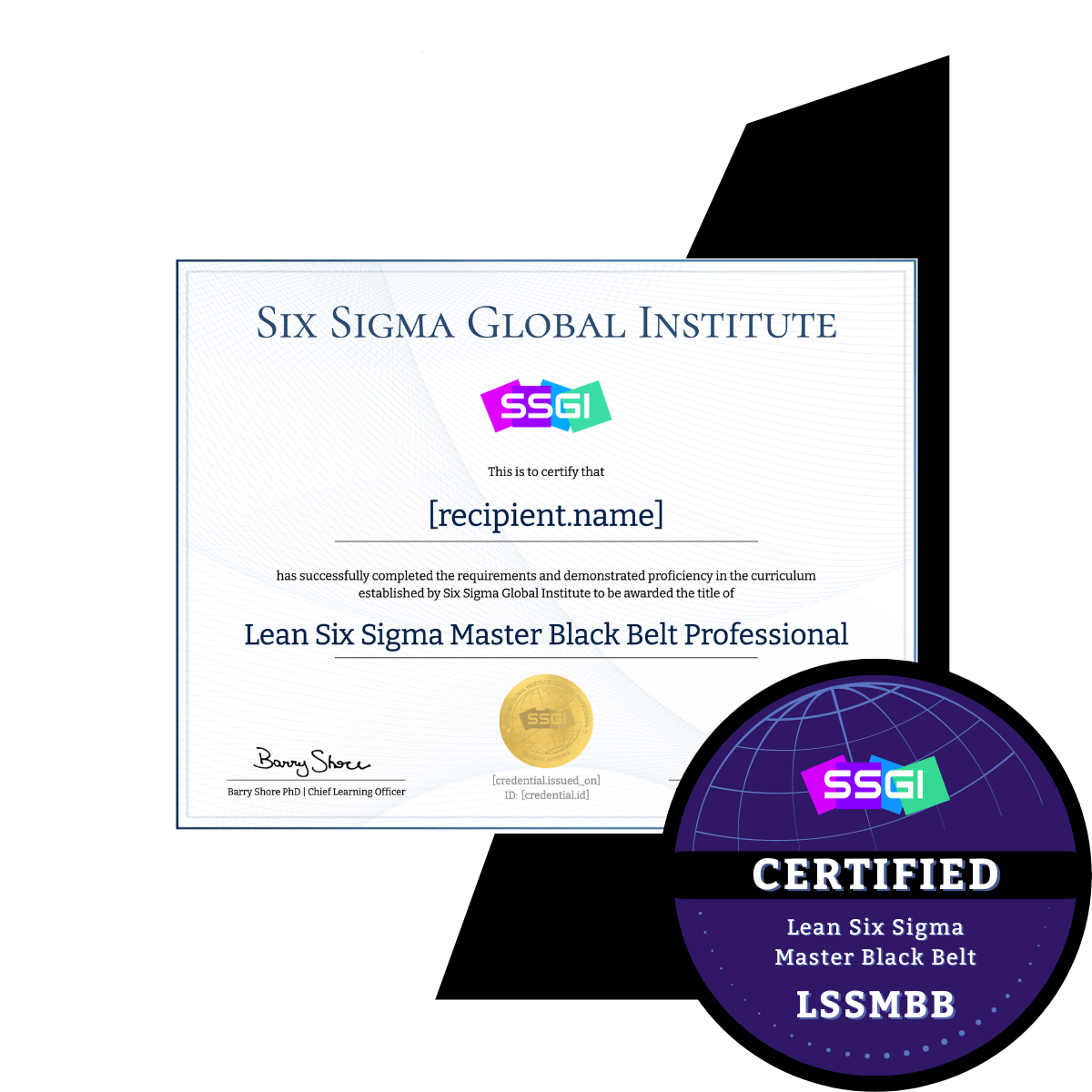
Master Black Belt Training & Certification for IT & Technology Professionals
Best for: Senior executives, IT leaders, transformation directors, and process excellence strategists.
Overview: The Master Black Belt certification represents the highest level of Six Sigma expertise, empowering professionals to lead enterprise-wide improvement and transformation initiatives across IT and technology organizations. Master Black Belts serve as mentors, coaches, and strategic advisors, ensuring all process improvement efforts align with organizational goals, customer needs, and long-term digital strategy.
✅ Coach and mentor Six Sigma teams across software development, IT operations, and cybersecurity functions.
✅ Design and oversee large-scale quality, performance, and efficiency initiatives.
✅ Drive sustainable improvement, innovation, and operational excellence across the global technology landscape.






Lean Six Sigma in IT & Technology FAQs
What is Six Sigma in IT and Technology?
Six Sigma in IT and Technology refers to the use of data-driven methods to identify inefficiencies, eliminate process variation, and improve the quality of technology operations. It helps teams streamline workflows in software development, IT service management, DevOps, and system maintenance.
How is Six Sigma used in the IT industry?
Organizations apply Six Sigma to improve software quality, reduce system downtime, optimize project management, and enhance end-user satisfaction. Common applications include defect reduction in development, faster incident resolution, and more consistent service delivery across IT operations.
Why should IT professionals get Six Sigma certified?
Six Sigma certification equips IT professionals with problem-solving, analytical, and process improvement skills that are valuable across all technology roles. It demonstrates expertise in driving efficiency, quality, and reliability — qualities that employers highly value in technical and leadership positions.
Which Six Sigma Belt is best for IT professionals?
The ideal certification depends on your experience level.
Yellow Belt: Best for beginners or team members supporting IT improvement projects.
Green Belt: Suitable for project managers, analysts, and mid-level professionals leading process initiatives.
Black Belt: Designed for IT leaders driving large-scale transformation.
Master Black Belt: For senior executives mentoring teams and overseeing enterprise-wide improvements.
How much do Six Sigma-certified IT professionals earn?
On average, Six Sigma-certified IT professionals earn $95,000+ per year, depending on their role, certification level, and experience. Black Belt and Master Black Belt holders typically command higher salaries due to their leadership responsibilities and advanced skill sets.
Is Six Sigma relevant for software developers or engineers?
Yes. Software developers and engineers use Six Sigma to reduce coding defects, improve testing processes, and enhance product reliability. It’s especially beneficial for professionals involved in DevOps, quality assurance, and agile project environments.
Can Six Sigma be combined with Agile or DevOps practices?
Absolutely. Six Sigma complements Agile and DevOps by adding structure, measurement, and continuous improvement to iterative workflows. The combination helps teams deliver higher-quality products faster while maintaining consistency and performance.
Which industries hire Six Sigma-certified IT professionals?
Technology companies, financial institutions, healthcare organizations, and government agencies all hire Six Sigma-certified IT professionals to lead process optimization and digital transformation projects.
Are SSGI’s Six Sigma certifications recognized globally?
Yes. SSGI certifications are developed by Dr. Barry Shore, McGraw-Hill award-winning professor, and offered in partnership with the Baldrige Foundation, the organization behind the Malcolm Baldrige National Quality Award — ensuring global credibility and recognition.
How do I get started with Six Sigma certification for IT and technology?
You can begin with the Lean Six Sigma Yellow Belt or Green Belt program from SSGI. All courses are 100% online, self-paced, and designed to fit your schedule, with lifetime access and certification included.