
What is Scrum? Scrum is a lightweight Agile framework that uses short, time-boxed iterations called Sprints to help teams deliver value quickly, adapt to change, and continuously improve through collaboration and transparency.
Scrum is a lightweight yet powerful agile project management framework used to manage complex projects, especially in Agile software development. It promotes teamwork, accountability, and continuous improvement by breaking work into short, time-boxed iterations called Sprints. Scrum helps teams deliver value quickly and respond to change effectively by emphasizing collaboration, transparency, and iterative progress.
Used across industries like technology, finance, healthcare, and manufacturing, Scrum is one of the most widely adopted Agile methodologies in the world. It’s ideal for teams that need to stay flexible while consistently delivering high-quality results.
Watch: Dr. Barry Shore explains the fundamentals of Scrum in this 3-minute video overview.
History and Origins of Scrum
What is the history of Scrum? Scrum was first introduced in 1986 by Takeuchi and Nonaka, then formalized in the 1990s by Ken Schwaber and Jeff Sutherland. It began in software development but gained momentum with the Agile Manifesto in 2001, and is now used across industries worldwide.
Scrum originated in the early 1990s as a new way to manage complex software development projects. The term “Scrum” was first introduced by Hirotaka Takeuchi and Ikujiro Nonaka in a 1986 Harvard Business Review article, which compared high-performing product development teams to rugby teams moving the ball down the field in unison.
Building on these ideas, Ken Schwaber and Jeff Sutherland formalized Scrum in the 1990s and later helped shape the Agile Manifesto in 2001. Since then, Scrum has become the most widely adopted Agile framework, spreading far beyond software into industries like healthcare, finance, government, and manufacturing. Its popularity comes from its adaptability, simplicity, and proven ability to help teams deliver value faster.
Scrum Principles and Core Ideas
What are the core principals of Scrum? Scrum is guided by five principles: time-boxing, incremental delivery, transparency, inspection, and adaptation. Together, they help teams stay focused, deliver usable results in short cycles, and continuously improve based on feedback.
At its core, Scrum is built on a set of principles that guide teams toward collaboration, adaptability, and continuous improvement:
Time-boxing
Work is divided into fixed-length sprints, usually 2–4 weeks, to maintain focus and deliver value quickly.
Incremental delivery
Each sprint produces a usable product increment, allowing for early feedback and rapid learning.
Transparency
Progress, goals, and challenges are visible to all stakeholders to encourage trust and accountability.
Inspection
Teams regularly review both their product and their process to identify opportunities for improvement.
Adaptation
Based on feedback, the team adjusts plans and priorities to stay aligned with customer needs and business goals.
These principles ensure Scrum teams remain flexible, outcome-focused, and able to thrive even in fast-changing environments.
Scrum Roles and Responsibilities
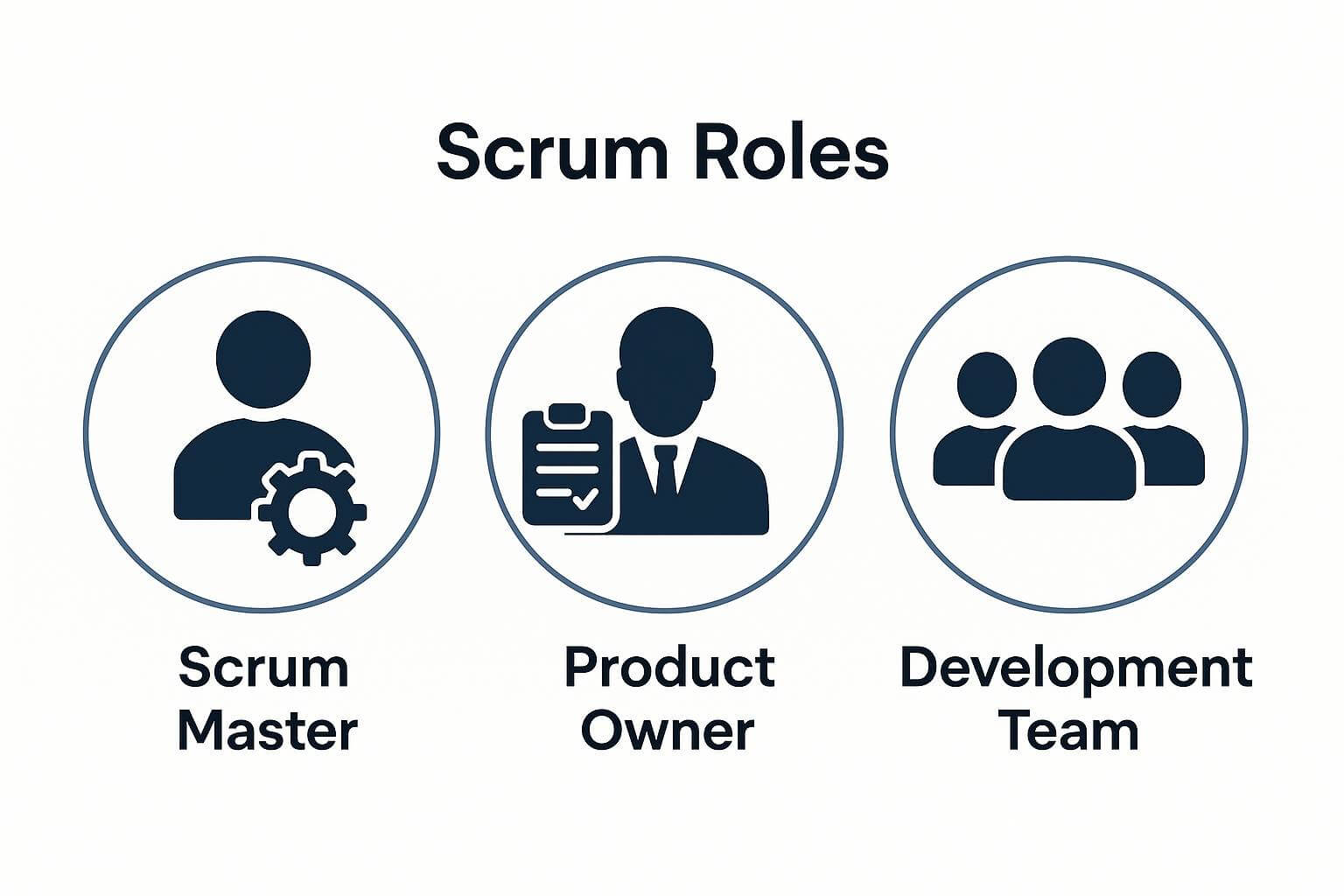
What are Scrum roles? Scrum roles define clear responsibilities within the framework. They include the Product Owner (sets priorities and defines the backlog), the Scrum Master (facilitates the process and removes obstacles), and the Development Team (delivers the work in sprints). Together, these roles ensure accountability, transparency, and collaboration.
In Agile project management, Scrum provides a clear structure built around defined roles and responsibilities. Each team member plays a vital part in driving projects forward, ensuring transparency, accountability, and high-quality delivery.
In this guide, we’ll break down the three core Scrum roles—Scrum Master, Product Owner, and Development Team—along with their specific responsibilities, how they collaborate, and what makes this framework so effective. Whether you’re new to Agile or looking to deepen your understanding, this article will clarify the who, what, and why behind Scrum team success.
Scrum defines three core roles, each with specific responsibilities that ensure the team works efficiently and stays aligned with project goals:
1. Scrum Master
The Scrum Master is the facilitator and coach of the team. Their main responsibility is to ensure that Scrum principles are followed and that the team can work effectively without unnecessary blockers.
Primary responsibilities include:
Facilitating Scrum ceremonies (daily stand-ups, sprint planning, reviews, retrospectives)
Coaching the team on Agile and Scrum best practices
Removing internal and external obstacles to progress
Supporting continuous improvement and collaboration
Shielding the team from distractions
Promoting team accountability and ownership
The Scrum Master is not a project manager, they do not assign tasks or control deadlines. Instead, they act as a servant leader, empowering the team to self-organize and thrive. Learn more about Scrum Master certification.
2. Product Owner
The Product Owner serves as the voice of the customer. They are responsible for maximizing the value of the product and managing the product backlog to ensure the team builds what matters most.
Primary responsibilities include:
Defining and prioritizing the product backlog
Writing clear user stories with acceptance criteria
Collaborating with stakeholders to capture business needs
Making trade-offs and decisions about features
Accepting or rejecting deliverables at the end of sprints
Ensuring the team works on the highest-value items
The Product Owner balances technical feasibility with business goals. They bridge the gap between what users want and what the development team can deliver. Learn more about Product Owner certification.
3. Development Team
The Development Team is a cross-functional group of professionals who build the product. These members are responsible for delivering potentially shippable product increments at the end of each sprint.
Primary responsibilities include:
Planning and executing work during the sprint
Collaborating closely and self-organizing to meet goals
Participating in all Scrum ceremonies
Owning the delivery of sprint commitments
Estimating work and identifying dependencies
Maintaining high-quality standards through testing and review
Scrum does not distinguish roles within the development team (e.g., designer, developer, tester)—everyone shares collective ownership of delivery.
Scrum Artifacts
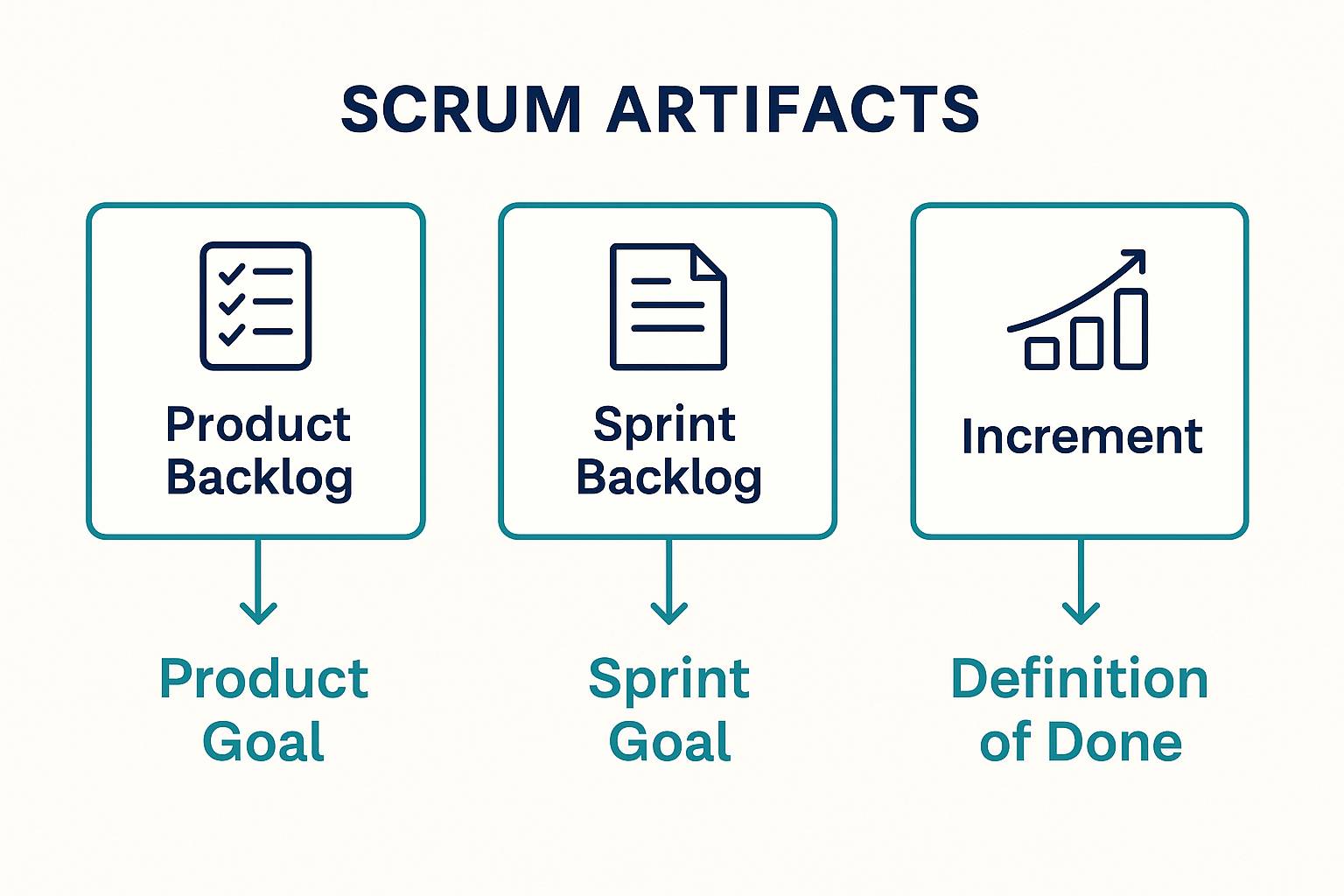
What are Scrum artifacts? Scrum artifacts are the key deliverables that provide visibility into the work. They include the Product Backlog (a prioritized list of requirements), the Sprint Backlog (items selected for the current sprint), and the Increment (the usable outcome of each sprint). These artifacts track progress and align the team toward shared goals.
Scrum artifacts capture the work and the value you plan to deliver. There are three core artifacts: Product Backlog, Sprint Backlog, and Increment. Each artifact has a built-in commitment that improves transparency and alignment:
Product Backlog → Product Goal
Sprint Backlog → Sprint Goal
Increment → Definition of Done
Together they help teams see what matters, plan how to deliver it, and verify that it is truly done.
1. Product Backlog
What it is: An ordered list of everything that could improve the product. It is the single source of work for the Scrum Team.
Owned by: Product Owner. Developers collaborate, but the Product Owner is accountable for ordering and clarity.
Commitment: Product Goal
A measurable, long-lived objective for the product that guides backlog ordering.
Good Product Backlog Items include: clear value statement, acceptance criteria, a small enough scope to complete within a sprint once selected, and a definition of how to test.
Practices that keep it healthy:
Regular refinement to split large items, clarify value, and reduce uncertainty
Ordering by outcome and risk, not by who shouted loudest
Adding discovery work such as experiments and technical spikes when needed
Example Product Goal: Reduce average onboarding time to under 10 minutes for new users.
2. Sprint Backlog
What it is: A plan for the current sprint that includes selected Product Backlog Items, a Sprint Goal, and a plan for delivering the Increment.
Owned by: Developers. They create and adapt the plan daily.
Commitment: Sprint Goal
A single objective for the sprint that gives the team focus and flexibility.
What makes a strong Sprint Backlog:
A concise Sprint Goal that describes the value, not the tasks
Selected PBIs that together achieve the goal
A visible plan that evolves as the team learns more
Example Sprint Goal: New users can complete sign-up with Google and reach the dashboard in under one minute.
3. Increment
What it is: A concrete step toward the Product Goal. Every Increment must be in a usable state and meet the team’s Definition of Done. There can be multiple increments in a sprint.
Owned by: The Scrum Team. Anyone can release when an Increment meets the Definition of Done and it makes sense for stakeholders.
Commitment: Definition of Done
A shared quality bar that applies to every Increment. If work does not meet the Definition of Done, it is not part of the Increment.
Example Definition of Done highlights: code reviewed, unit tests added and passing, security checks green, integrated to main branch, feature flagged or documented, release notes drafted when applicable.
Commitments at a Glance
Product Backlog → Product Goal: guides long-term direction and ordering
Sprint Backlog → Sprint Goal: aligns work for the sprint and creates focus
Increment → Definition of Done: ensures quality and transparency of what is done
How the Artifacts Flow Through a Sprint
Product Owner orders the Product Backlog toward the Product Goal
During Sprint Planning, Developers select PBIs and craft a Sprint Goal
Developers adapt the Sprint Backlog as they learn and build
Each completed PBI that meets the Definition of Done adds to the Increment
The team inspects the Increment in the Sprint Review and updates the Product Backlog
Quick FAQs on Scrum Artifacts
How detailed should the Product Backlog be?
Enough to enable ordering and selection. Details grow as items near the top.
Can the Sprint Backlog change mid-sprint?
Yes. The Sprint Goal remains the same, but the plan can evolve as the team learns.
Do we have to release every sprint?
No. You must produce a usable Increment that meets the Definition of Done. Release when it makes sense for stakeholders.
Who writes the Definition of Done?
The Scrum Team. It should be transparent and enforced consistently.
Scrum Events (Ceremonies)
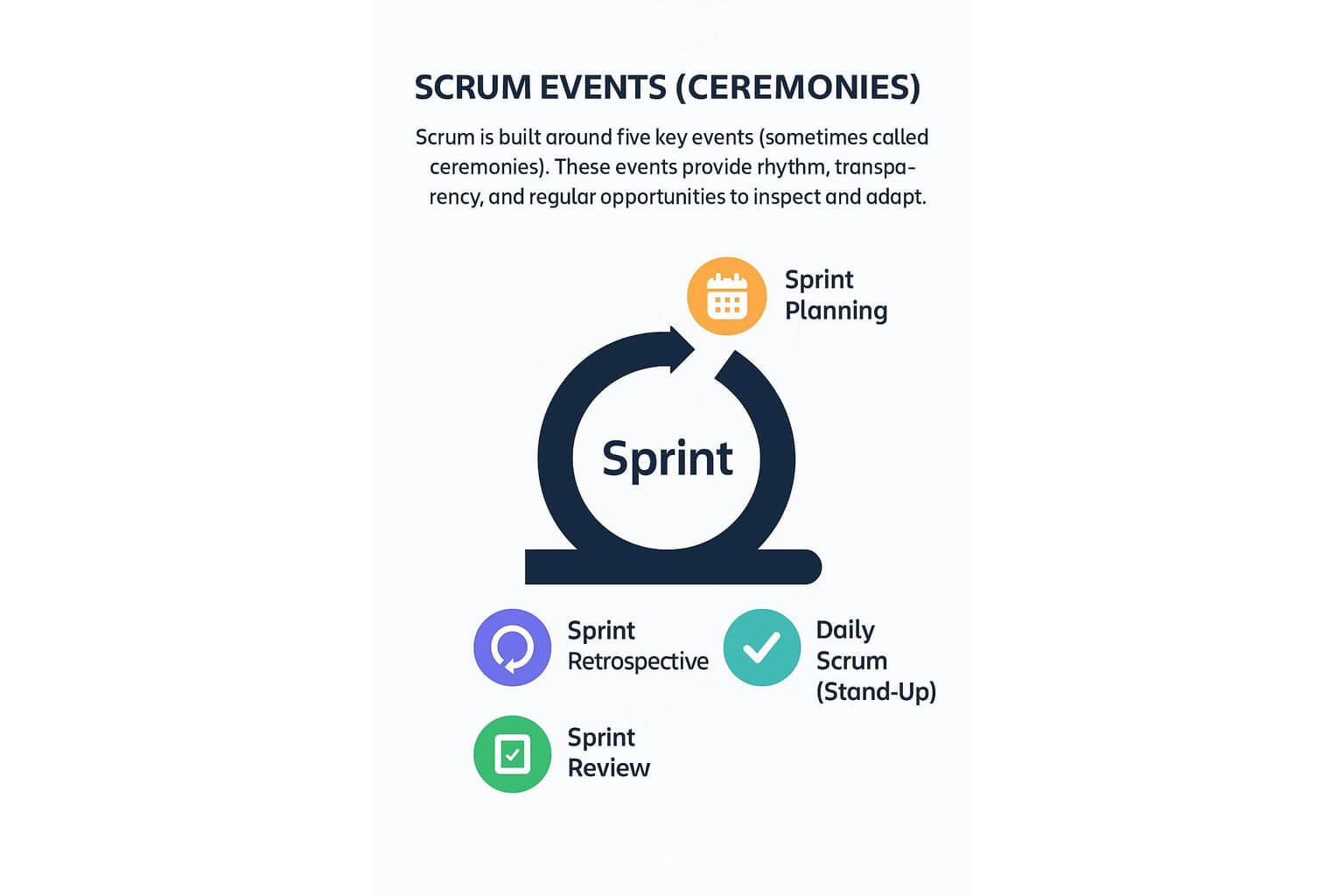
What are Scrum events? Scrum events are time-boxed meetings that structure the workflow. They include Sprint Planning (defining work for the sprint), the Daily Scrum (a short alignment meeting), the Sprint Review (inspection of the increment), and the Sprint Retrospective (continuous improvement). These events promote focus, feedback, and adaptability.
Scrum is built around five key events (sometimes called ceremonies). These events provide rhythm, transparency, and regular opportunities to inspect and adapt. Together, they create the structure that helps Scrum Teams deliver value consistently.
The five Scrum events are:
Sprint
Sprint Planning
Daily Scrum (Stand-Up)
Sprint Review
Sprint Retrospective
1. The Sprint
The Sprint is the heartbeat of Scrum. It is a fixed-length timebox of one month or less during which a usable Increment is created. Most teams choose a two-week sprint to balance focus with fast feedback.
Purpose: Provide a predictable rhythm for delivering value.
Consistency: Sprint length remains stable, helping teams measure velocity and improve forecasting.
Scope: The Sprint Goal stays fixed, but the Sprint Backlog may evolve as the team learns.
Rule of thumb: The more complex or uncertain the work, the shorter the sprint should be.
2. Sprint Planning
Sprint Planning kicks off the Sprint and sets the team’s direction. It is a collaborative session where the Scrum Team answers three key questions:
Why is this sprint valuable? → Defines the Sprint Goal.
What can be done this sprint? → Developers select Product Backlog Items they believe they can complete.
How will the chosen work get done? → Developers outline a plan for delivering the Increment.
Output of Sprint Planning:
A clear Sprint Goal understood by everyone.
A set of Product Backlog Items selected for the sprint.
A plan for how to deliver them.
⏱ Timebox: For a one-month Sprint, planning is max 8 hours; proportionally shorter for shorter sprints.
3. Daily Scrum (Daily Stand-Up)
The Daily Scrum is a 15-minute event for Developers to synchronize work and adjust their plan for the next 24 hours.
Focus: Progress toward the Sprint Goal, not status reporting.
Format: Teams often answer these guiding questions:
- What did we complete yesterday?
- What will we do today?
- What obstacles are in the way?
Tips for effectiveness:
Keep it timeboxed at 15 minutes.
Hold it at the same time and place for consistency.
Use visual tools (Kanban board, burndown chart) to stay aligned.
The Daily Scrum is not for managers or stakeholders—it is by and for the Developers.
4. Sprint Review
At the end of the Sprint, the team holds a Sprint Review to inspect the Increment and adapt the Product Backlog if needed.
Participants: Scrum Team and key stakeholders.
Focus: What was accomplished during the sprint, what has changed in the environment, and what should be done next.
Deliverables: Demonstration of completed Product Backlog Items (Increment) and collaborative discussion of next steps.
Outcome: A Product Backlog adapted to maximize value before the next Sprint.
⏱ Timebox: For a one-month Sprint, max 4 hours; proportionally less for shorter sprints.
5. Sprint Retrospective
The Sprint Retrospective closes out the Sprint and focuses on continuous improvement.
Purpose: Inspect how the last Sprint went in terms of people, processes, tools, and teamwork.
Output: At least one concrete improvement action to apply in the next Sprint.
Mindset: A safe space for honesty—celebrate wins, identify pain points, and agree on small, impactful changes.
⏱ Timebox: For a one-month Sprint, max 3 hours; proportionally less for shorter sprints.
Optional but Common: Backlog Refinement
Although not an official Scrum event, many teams also run Backlog Refinement (or Grooming) sessions mid-sprint. This is when the Product Owner and Developers:
Break down large Product Backlog Items into smaller ones.
Add acceptance criteria and estimates.
Ensure high-priority items are “ready” for future sprints.
Scrum Events Comparison Chart
| Event | Timebox | Purpose | Participants | Commitment |
|---|---|---|---|---|
| Sprint | ≤ 1 month | Deliver a usable Increment | Scrum Team | Sprint Goal |
| Sprint Planning | 8 hrs (1-mo Sprint) | Decide why, what, and how | Scrum Team | Sprint Goal |
| Daily Scrum | 15 min | Inspect progress, adapt plan | Developers | Sprint Goal |
| Sprint Review | 4 hrs (1-mo Sprint) | Inspect Increment & adapt Product Backlog | Scrum Team + stakeholders | Product Goal |
| Sprint Retrospective | 3 hrs (1-mo Sprint) | Inspect & improve process | Scrum Team | Definition of Done |
Quick FAQs on Scrum Events
Do we have to hold every Scrum event?
Yes. All five events are required to provide transparency and opportunities to inspect and adapt.
How is Scrum different from other Agile ceremonies?
Scrum focuses on five lightweight, timeboxed events. Kanban or XP may use different cadences, but Scrum events are designed to reinforce empiricism.
Can we combine or skip events?
You can experiment, but skipping events reduces transparency and weakens Scrum. If you’re just starting, follow the framework fully before adapting.
Scrum Values
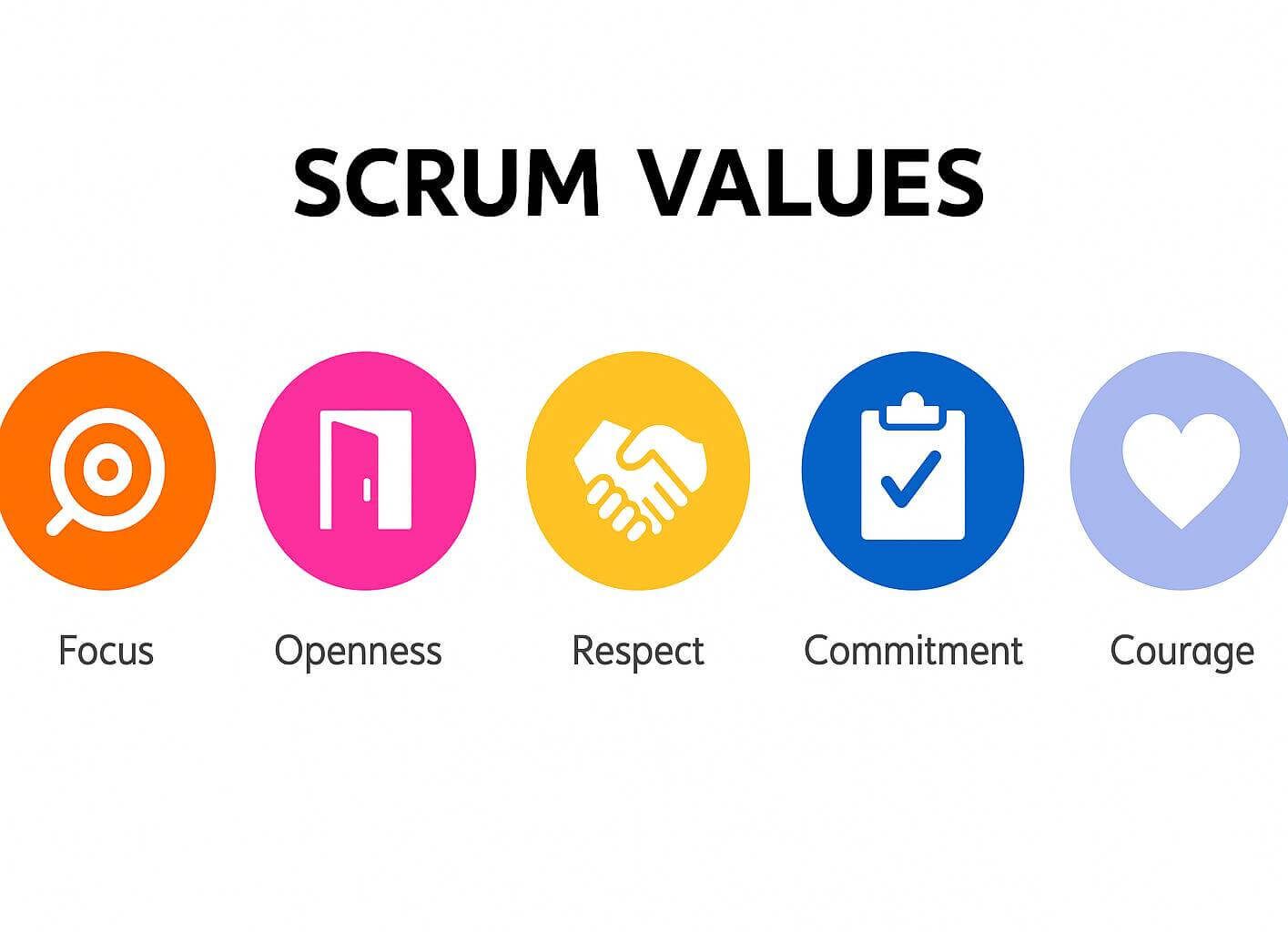
What are the Scrum values? The five Scrum values are Commitment, Focus, Openness, Respect, and Courage. These values guide how the Scrum Team works together and makes decisions. They create a culture of trust and accountability, where team members stay focused on sprint goals, commit to delivering value, communicate openly, respect each other’s contributions, and have the courage to adapt when challenges arise.
In addition to roles, artifacts, and events, the Scrum framework is grounded in five core values: Commitment, Courage, Focus, Openness, and Respect. These values were formally added to the Scrum Guide in 2016 and shape the culture and behavior of every Scrum Team.
Without these values, Scrum devolves into mechanical process. With them, teams build trust, collaboration, and the mindset needed to deliver real value.
Commitment
Scrum teams thrive on shared accountability. Each member commits to the Sprint Goal and to the team, not just to individual tasks.
Commitment means taking ownership of outcomes, not just checking boxes.
It discourages overcommitting by ensuring that goals are realistic and agreed upon by the whole team.
Progress toward commitments is made transparent in events such as the Daily Scrum and Sprint Review.
Example: Instead of saying “I’ll try to finish this task,” a Developer commits with the team to “deliver a working login feature that meets the Definition of Done this Sprint.”
Courage
Scrum is built on empiricism—learning by doing—and that requires courage.
Courage to be transparent about progress, setbacks, or blockers.
Courage to question outdated processes or unhelpful requirements.
Courage to innovate, experiment, and try new approaches even if they fail.
Teams with courage create a safe environment where challenges are discussed openly and addressed quickly.
Example: A Developer raises a concern that the Sprint Goal is too ambitious, even if it feels uncomfortable to challenge the Product Owner.
Focus
The Sprint itself creates a timeboxed window for focus. Teams avoid multitasking and distractions, channeling their energy toward the Sprint Goal.
Focus ensures that high-value work gets completed instead of spreading efforts thin.
The Product Owner helps by prioritizing the most important items in the Product Backlog.
Daily Scrums reinforce focus by aligning everyone on what matters most today.
Example: During the Sprint, the team resists pulling in “nice-to-have” items that don’t support the agreed Sprint Goal.
Openness
Scrum thrives on transparency. Work, progress, challenges, and ideas must be visible and openly discussed.
Daily Scrums foster openness by encouraging honest updates and surfacing blockers.
Sprint Reviews invite stakeholders to provide feedback, even if it means changing direction.
Openness builds trust within the team and with the organization.
Example: A Scrum Team openly discusses technical debt that could slow future progress, even if stakeholders might prefer it stay hidden.
Respect
Scrum Teams succeed only through collaboration and mutual respect.
Respect acknowledges that each role—Product Owner, Scrum Master, and Developers—adds unique value.
Team members celebrate one another’s contributions and accomplishments.
Respect extends beyond the Scrum Team to stakeholders and customers.
Example: Instead of blaming a team member for delays, the team discusses how to improve processes together.
Why Scrum Values Matter
The five values aren’t just ideals; they directly enable Scrum’s success:
Commitment drives accountability.
Courage fuels innovation and transparency.
Focus ensures consistent delivery.
Openness builds trust and adaptability.
Respect strengthens collaboration and morale.
When practiced consistently, the Scrum Values create a culture where teams are empowered to deliver valuable increments every Sprint.
How Scrum Roles Work Together
While each role has a distinct purpose, success in Scrum depends on collaboration. The Product Owner defines the “what,” the Development Team decides the “how,” and the Scrum Master enables the “how well.”
This triangle of collaboration fosters:
Transparency in work and goals
Faster decision-making
Higher adaptability to change
Stronger team accountability
With clearly defined boundaries and responsibilities, Scrum teams avoid role confusion and maintain focus on value delivery.
Scrum Master vs Product Owner
Scrum relies on clearly defined roles to ensure agility, focus, and accountability within a team. Two of the most critical roles in the Scrum framework are the Scrum Master and the Product Owner — but they serve very different purposes.
If you’re exploring Agile career paths, it’s important to understand how these two roles compare in responsibilities, required skills, and how they contribute to a successful Scrum team.
Below you’ll find two short video overviews explaining the key functions, expectations, and career outlook for each role.
Scrum Master Overview
What does a Scrum Master do, and how do they support the Scrum team and Agile process?
Product Owner Overview
What is the role of the Product Owner, and how do they manage priorities and stakeholder needs?
Key Differences: Scrum Master vs Product Owner
| Role | Focus Area | Responsibilities | Interaction With |
|---|---|---|---|
| Scrum Master | Process and Team Facilitation | Guides the team, removes blockers, ensures Scrum is followed | Development Team |
| Product Owner | Product Vision and Business Value | Manages the product backlog, prioritizes features, aligns with stakeholders | Stakeholders & Scrum Team |
The Scrum Master is a servant leader focused on facilitating the process.
The Product Owner is the voice of the customer, responsible for maximizing product value.
Which Role Is Right for You?
Choose Scrum Master if you enjoy coaching teams, removing obstacles, and enabling continuous improvement.
Choose Product Owner if you’re more focused on business strategy, stakeholder communication, and product decision-making.
Get Certified with SSGI
Whether you’re pursuing a career as a Scrum Master or Product Owner, we offer 100% online, self-paced certification programs developed by Dr. Barry Shore — a McGraw-Hill award-winning professor with 40+ years of experience.
Scrum vs. Kanban vs. Waterfall: Key Differences
When exploring Agile methodologies, many teams find themselves comparing Scrum, Kanban, and Waterfall. Each approach offers a unique framework for managing projects, and knowing the differences can help you choose the right fit for your team.
The table below outlines how these three methodologies differ in terms of structure, flexibility, and best use cases.
| Feature | Scrum | Kanban | Waterfall |
|---|---|---|---|
| Approach | Iterative and incremental | Continuous flow | Sequential and linear |
| Roles Defined | Yes (Scrum Master, Product Owner, Dev Team) | No specific roles | Project Manager, Business Analyst, etc. |
| Planning | Sprint-based (2–4 weeks) | On-demand | Upfront, rigid |
| Flexibility | High | High | Low |
| Best For | Complex projects with changing scope | Operational/maintenance work | Well-defined, fixed-scope projects |
Agile vs Waterfall: Which Delivers More Success?
When comparing project management methods, success rates tell an important story. Agile projects are nearly twice as likely to succeed compared to Waterfall, with far fewer outright failures. The iterative, flexible nature of Agile helps teams adapt quickly, while Waterfall’s rigid structure often leads to challenges and higher failure rates.

Scrum Roles vs. Traditional Roles
Many organizations transitioning from waterfall to Agile often ask how Scrum roles differ from traditional roles like Project Manager or Business Analyst.
Here’s a quick comparison:
| Role | Traditional Project Manager | Scrum Master |
|---|---|---|
| Planning | Controls timeline, scope | Facilitates team process |
| Authority | Has decision-making power | Servant leader, no authority |
| Focus | Delivering the plan | Optimizing team performance |
| Reporting | Reports to executives | Coaches team and removes blockers |
Common Misconceptions About Scrum Roles
Scrum Master = Project Manager?
No. Scrum Masters are facilitators, not task managers.
Product Owner = Scrum Boss?
No. They prioritize work but do not manage the team.
Development Team = Only Developers?
No. It includes anyone who contributes to delivering the product, including designers, QA, etc.
Benefits of Scrum
Organizations adopt Scrum because it delivers results. Here’s why teams rely on it:
Faster delivery through time-boxed sprints
Improved collaboration and communication
Greater transparency in goals and progress
Early and continuous feedback from stakeholders
Higher adaptability to change
These benefits make Scrum a favorite framework across tech, finance, healthcare, education, and more.
Career Opportunities for Scrum Professionals
As organizations continue to adopt Agile, professionals with Scrum expertise are in high demand. Here are common job titles associated with each role:
Scrum Master
Agile Coach, Scrum Team Lead & Agile Delivery Manager
Product Owner
Product Manager, Technical Product Owner & Business Analyst
Development Team
Front-End Developer, UX Designer, QA Analyst & DevOps Engineer
Many professionals also go on to pursue certifications like Certified ScrumMaster (CSM), Product Owner Certification, or Scaled Agile (SAFe) credentials to further their careers.
How Scrum Is Used Across Industries
Scrum isn’t just for software development—organizations across industries are using it to boost efficiency, collaboration, and outcomes. From hospitals to marketing agencies, Scrum offers a flexible yet powerful framework that helps teams stay organized, focused, and aligned with goals.
Below, Dr. Barry Shore explains how Scrum is applied in two very different (but equally dynamic) fields: marketing and healthcare.
Scrum in Marketing
Learn how Agile marketing teams apply Scrum to manage campaigns, streamline content creation, and deliver value faster—with fewer bottlenecks.
Scrum in Healthcare
Discover how hospitals and healthcare organizations use Scrum to improve patient care, reduce delays, and implement continuous improvement in clinical settings.
Getting Started with Scrum
Scrum may look simple on paper, but its real power comes from practice. The framework’s rules, artifacts, events, and roles are intentionally lightweight and easy to understand, yet they provide just enough structure to remove ambiguity while allowing teams to adapt Scrum to their unique environment.
By breaking down complex initiatives into manageable user stories and short, focused Sprints, Scrum enables teams to deliver usable results faster, with greater transparency and shared ownership. This rhythm of continuous feedback keeps teams motivated and helps stakeholders see progress regularly.
For organizations used to traditional project management, Scrum can feel like a cultural shift. Smaller iterations, daily collaboration, and empowered roles like the Scrum Master and Product Owner may take time to fully embrace. But once adopted, the long-term benefits — faster delivery, improved adaptability, and stronger team alignment, far outweigh the learning curve.
Scrum’s widespread success across technology, healthcare, finance, manufacturing, and beyond makes it one of the most practical frameworks for tackling complex work.
👉 Want to learn Scrum in a structured way? Explore our Scrum Master Certification course developed by Dr. Barry Shore, to gain the skills, tools, and confidence to apply Scrum effectively in your team or organization.
Scrum FAQs
Q: What are the 3 roles in Scrum?
A: The three core roles in Scrum are Scrum Master, Product Owner, and Development Team.
Q: What is Scrum?
A: Scrum is an Agile framework that helps teams work together to deliver projects in small, manageable pieces called Sprints. It focuses on collaboration, transparency, and continuous improvement so teams can adapt quickly and deliver value faster.
Q: What does a Scrum Master do?
A: A Scrum Master facilitates the Scrum process, supports the team, removes blockers, and promotes continuous improvement.
Q: What is the role of the Product Owner?
A: The Product Owner manages the product backlog, prioritizes features, and ensures the team works on high-value items.
Q: Can one person be both Scrum Master and Product Owner?
A: While possible in very small teams, it’s not recommended due to conflicting responsibilities and potential bias in decision-making.
Q: How do Scrum roles work together?
A: The Product Owner defines what to build, the Development Team builds it, and the Scrum Master ensures the process runs smoothly.
Q: Is Scrum only for software?
A: No — Scrum started in software development but is now used across many industries, including healthcare, finance, manufacturing, and government. Its focus on collaboration, short cycles, and continuous improvement makes it effective for any complex project.
Q: How does Scrum differ from Kanban?
A: Scrum is an Agile framework with defined roles, events, and sprints, while Kanban is a visual workflow method that focuses on continuous flow and limiting work in progress. Scrum is more structured, whereas Kanban offers flexibility without prescribed time-boxes.