What Is Continuous Improvement? A Complete Guide
Definition, Examples, Methods, and Business Benefits

Definition, Examples, Methods, and Business Benefits
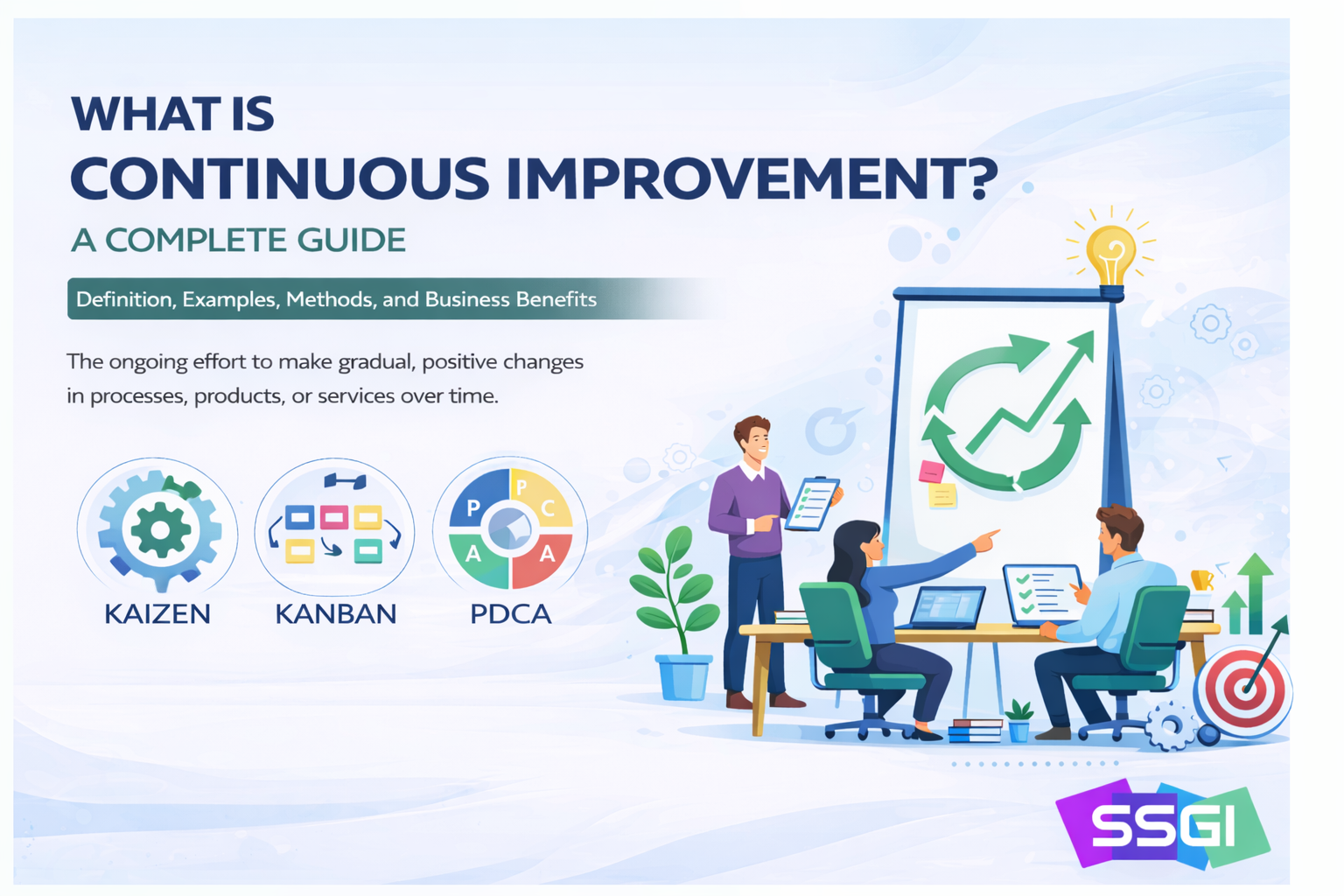
Continuous improvement is the ongoing effort to improve processes, products, services, and systems through small, incremental changes over time. It is a foundational concept in Lean, Six Sigma, Agile, and Operational Excellence (OPEX) because it helps organizations improve performance, reduce waste, and create more consistent results.
In this guide, you’ll learn what continuous improvement means, how it relates to Kaizen, Kanban, and PDCA, and how organizations use it to improve efficiency, quality, and business performance.
Continuous improvement is the ongoing effort to improve processes, products, services, and systems through small, incremental changes over time. Instead of relying on large, disruptive transformations, it focuses on consistent, sustainable improvements that build long-term performance.
Many organizations claim to practice continuous improvement, but their efforts often stall because they rely on disconnected tools, lack leadership support, or focus on isolated fixes instead of building sustainable systems.
True continuous improvement is not a one-time initiative. It is a way of operating that makes improvement part of daily work, problem-solving, and decision-making across the organization through structured approaches like Lean Six Sigma.
Continuous improvement is built on a set of core principles that guide how organizations improve performance, solve problems, and sustain results over time.
Continuous improvement focuses on small, manageable changes that build over time. Instead of relying on large transformations, organizations improve performance through consistent, incremental progress.
Sustainable improvement requires participation across the organization. From frontline employees to leadership, everyone plays a role in identifying problems and contributing solutions.
Effective improvement is based on data, not assumptions. Measuring performance and analyzing results ensures that changes lead to real, measurable gains.
Every improvement should ultimately enhance the customer experience. Organizations evaluate changes based on their impact on quality, service, and value delivery.
Continuous improvement is not about quick fixes. Successful changes are standardized, monitored, and continuously refined to ensure long-term results.
Continuous improvement follows a structured cycle that allows organizations to test changes, measure results, and continuously refine processes over time. One of the most widely used models is the Plan-Do-Check-Act (PDCA) cycle.
While PDCA is widely used, many organizations also apply structured approaches like DMAIC (Define, Measure, Analyze, Improve, Control) or Kaizen-based daily improvement practices.
Plan
Identify a problem or opportunity and develop a solution based on data, analysis, or feedback.
Do
Implement the change on a small scale to test its effectiveness.
Check
Measure results and evaluate whether the change improved performance.
Act
Standardize successful changes or refine the approach and repeat the cycle.
Many professionals learn to apply these methods through structured training such as Lean Six Sigma certification programs.
The PDCA cycle enables organizations to test changes, measure results, and continuously refine processes, making it a core driver of operational excellence.
Many organizations treat continuous improvement as a series of isolated projects. In reality, the most effective organizations build systems where improvement happens continuously as part of daily work.
This is why training, leadership alignment, and structured methodologies are critical to long-term success.
Continuous improvement is the overarching philosophy, while Kaizen, Kanban, and DMAIC are structured methods used to implement it.
While these terms are often used interchangeably, they serve different roles within process improvement and operational excellence.
To better understand how continuous improvement compares to popular methodologies like Kaizen, Kanban, and DMAIC, here’s a quick breakdown:
| Method / Concept | Focus |
|---|---|
| Continuous Improvement | Broad philosophy across industries |
| Kaizen | Japanese philosophy of incremental workplace improvement |
| Kanban | Visual workflow management promoting steady progress |
| DMAIC | Structured Six Sigma method for defect reduction and process improvement |
Each approach plays a different role, but all contribute to the goal of achieving consistent, sustainable improvement across an organization.
Continuous improvement can be applied across industries to improve efficiency, reduce delays, and enhance customer experience. Here are a few real-world examples:
Manufacturing
Reducing machine downtime by standardizing maintenance procedures and implementing predictive maintenance schedules.
Lean Six Sigma in Manufacturing
Healthcare
Improving patient flow by analyzing admission and discharge processes to reduce delays and wait times.
Education
Streamlining enrollment by simplifying registration processes and automating communication with students.
Government
Reducing permit processing time by eliminating unnecessary steps and digitizing submissions.
Continuous improvement is supported by a set of tools that help teams identify problems, analyze root causes, and implement sustainable solutions.
PDCA Cycle
A four-step model for testing and refining process improvements.
Kanban Boards
Visual tools that help manage workflow and limit work in progress.
Root Cause Analysis (5 Whys, Fishbone Diagram)
Techniques used to identify the underlying causes of problems.
Value Stream Mapping
A visual method for analyzing process flow and identifying waste.
Control Charts
Statistical tools used to monitor process performance over time.
Kaizen Events
Short, focused improvement sessions aimed at solving specific problems quickly.
Organizations that implement continuous improvement effectively see measurable gains in performance, efficiency, and customer satisfaction.
Improved Efficiency
Streamlined processes reduce delays, rework, and waste.
Increased Customer Satisfaction
Better processes lead to more consistent quality and service.
Higher Employee Engagement
Employees become more involved in problem-solving and improvement efforts.
Reduced Costs
Eliminating inefficiencies lowers operational expenses.
Greater Adaptability
Organizations can respond more quickly to changes in customer needs and market conditions.
Continuous improvement skills are in high demand across industries, from manufacturing and healthcare to finance and technology. Formal training helps professionals develop the tools, frameworks, and practical skills needed to drive measurable results.
While many organizations attempt continuous improvement informally, structured Lean Six Sigma training and certification are often what enable teams to apply these concepts effectively in real-world environments.
At SSGI, we offer industry-recognized online certifications designed to support continuous improvement initiatives at every level:
Lean Six Sigma Yellow Belt Certification
Build foundational skills in process improvement, problem-solving, and Lean principles.
Lean Six Sigma Green Belt Certification
Learn to lead improvement projects using DMAIC, data analysis, and structured problem-solving.
Lean Six Sigma Black Belt Certification
Develop advanced skills to lead complex initiatives and drive organizational performance.
Career Track Programs
Career-focused programs that combine Lean, Six Sigma, and operational strategy.
Ready to build real continuous improvement skills?
Learn how to apply Lean, Six Sigma, and proven improvement frameworks to real-world processes. SSGI’s expert-led certification programs are designed to help you develop practical skills, not just earn a credential.
Continuous improvement is the ongoing effort to improve processes, products, and services through small, incremental changes over time.
Continuous improvement helps organizations improve efficiency, reduce costs, enhance quality, and respond more effectively to changing customer needs and market conditions.
An example of continuous improvement is reducing customer wait times by streamlining workflows, eliminating unnecessary steps, and continuously refining the process based on feedback and data.
Kaizen is a method within continuous improvement that focuses on small, daily improvements made by employees at all levels of an organization.
Yes, Kanban supports continuous improvement by visualizing workflows, limiting work in progress, and helping teams identify bottlenecks and improve flow.
The main principles of continuous improvement include incremental change, employee involvement, data-driven decision-making, customer focus, and sustaining improvements over time.
Common tools include the PDCA cycle, Kanban boards, root cause analysis (such as the 5 Whys), value stream mapping, and control charts.
Continuous improvement is a broad philosophy focused on ongoing improvement, while Six Sigma is a structured methodology that uses data and statistical analysis to reduce defects and improve processes.
The PDCA cycle stands for Plan, Do, Check, Act. It is a four-step method used to test changes, measure results, and continuously refine processes.
Continuous improvement is used across industries including manufacturing, healthcare, finance, government, technology, and education.
While certification is not required, formal training helps professionals learn structured methods like Lean and Six Sigma, making it easier to apply continuous improvement effectively in real-world environments.
Lean Six Sigma certifications, such as Yellow Belt, Green Belt, and Black Belt, are among the most widely recognized credentials for building continuous improvement skills.